In this article
- Why louvers are the slowest item in the house
- Counting panels, louvers and doors
- What the shutters are made of
- Paint in place or take them down
- The spraying setup
- Operable louvers and stuck slats
- Preparation on every slat
- Shutters on bay, arched and odd shaped windows
- Louvered closet doors and bifolds
- Scheduling the return trip
- Shop finishing and the cabinet connection
- Writing the shutter line
- Timing louvers on real jobs
- Frequently asked questions
Interior plantation shutters, louvered closet doors and louvered bifolds share one quality that makes them slow: they are made of dozens of thin slats, each with two faces, two edges and a joint at each end. A single shutter panel can contain more painted edge than a whole flat door. Customers see a window covering or a closet door and expect a modest price. Painters who have done a houseful of them know better.
This guide is for painting contractors pricing interior shutters and louvered doors. It covers how to count them, the choice between painting in place and removing them, the spraying setup most painters use, the risks particular to louvers, and how to write the line. Exterior shutters are a different job, covered in how much to charge to paint shutters.
Why louvers are the slowest item in the house
A louver is a small board. On an operable plantation shutter, it pivots on pins at each end and is linked to its neighbors by a tilt rod. On a fixed louver door, it sits in grooves in the stiles at an angle. Either way, the painter has to coat every face and edge of every slat, get paint into the corners where slats meet stiles, and avoid runs collecting on the lower edge of each slat.
Brushing louvers is slow and hard to do well. Paint builds up in the corners and sags on the lower edges. The inside faces of fixed louvers are hard to reach at all. This is why most painters spray louvered items, and why the pricing of louvers depends so heavily on the method.
Counting panels, louvers and doors
The inventory for shutters and louvered doors includes:
- Shutter panels, counted, with the number of louvers per panel and the louver width noted.
- Whether the louvers are operable or fixed, and whether there is a front tilt rod or a hidden one.
- Shutter frames, hanging strips and divider rails, measured or counted.
- Louvered doors and bifolds, counted, noted as full louver, half louver or louver over panel.
- Hardware: hinges, magnets, catches and track hardware on bifolds.
Band by louver count and type. A panel with a few wide louvers is faster than a panel of the same size with many narrow ones, because there are fewer slats and fewer joints. Full louver doors are slower than half louver doors. A painter might use bands such as small shutter panel, large shutter panel, half louver door and full louver door, each with its own rate from real jobs.
Interior doors without louvers are a separate item. The approach to them, and to door types generally, is covered in the cost to paint interior doors, and the interior door painting calculator helps with the material side.
What the shutters are made of
Interior plantation shutters are made of wood, composite, vinyl or a combination. Painted wood shutters can usually be repainted with the right preparation. Composite and vinyl shutters often have a factory finish that is not designed to be painted, and paint may not bond to it without a suitable primer. Some manufacturers state that painting affects their warranty.
Identify the material before quoting. If the shutters are composite or vinyl with a factory finish, advise the customer to check the manufacturer guidance first, and price the preparation and primer that the surface needs. Stained wood shutters being painted for the first time need deglossing and a bonding primer on every slat, which is a significant extra step.
Paint in place or take them down
Painting shutters in place avoids removal and reinstallation but makes spraying almost impossible without masking the whole window, wall and floor, and brushing in place is slow. It also leaves the window covering partly open while the paint dries, which some customers will not accept in a bedroom or bathroom.
Removing panels for painting is the usual approach. Shutter panels lift off their hinges or are unscrewed, labeled by location, and taken to a place where they can be sprayed and dried. Louvered doors come off their hinges or tracks in the same way. The frames usually stay in place and are brushed or masked and sprayed.
Removal adds its own work. Every panel needs a label that survives the painting process, every hinge pin and screw has to be kept, and every panel has to go back to the right opening and be adjusted so the louvers close and the panels align. Price the removal and reinstallation as their own line, and note any return visit.
The spraying setup
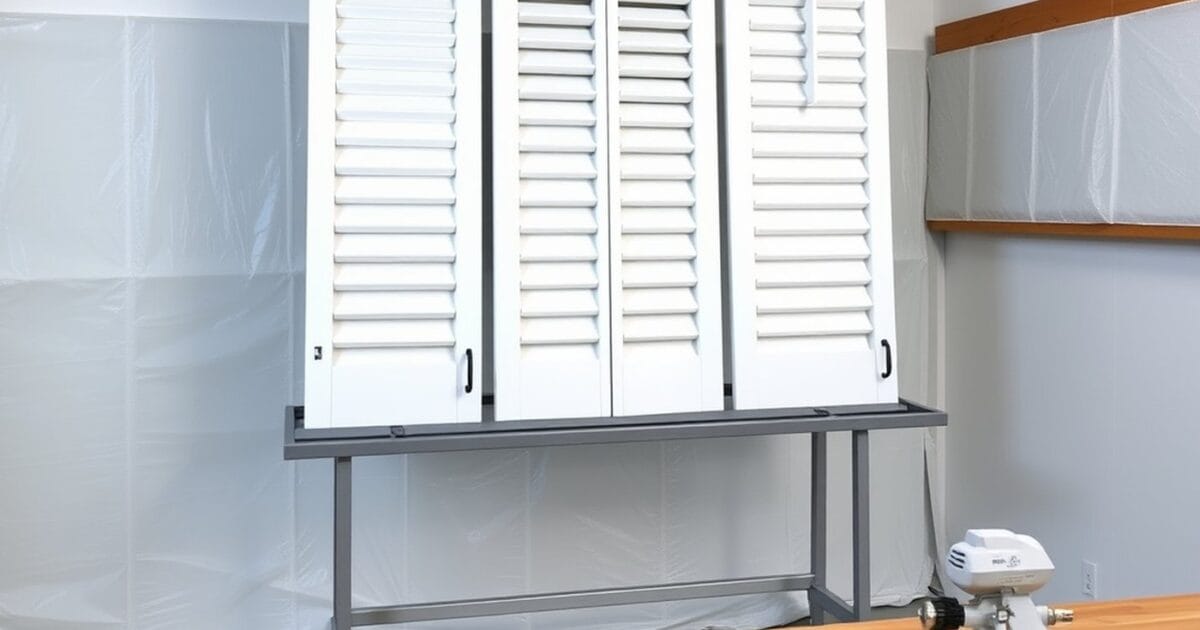
Spraying louvers gives the best finish and is usually the fastest method once the setup is in place. Painters spray in a shop, a garage, a spray tent or an outdoor area, with racks to hold panels while they dry. Each panel is sprayed on both faces with the louvers open at an angle, and then with the louvers turned, so that paint reaches every face and edge.
The setup has a cost. A shop or tent must be set up, masked and cleaned. Panels must be transported if they are sprayed off site. Drying racks take space, and panels need to cure before they are stacked or reinstalled. The general tradeoffs between spraying, rolling and brushing are set out in paint sprayer vs roller vs brush, and the method for using a sprayer is covered in how to use a paint sprayer.
Spraying indoors or in an enclosed space also brings safety requirements for ventilation and respiratory protection. OSHA provides guidance on spray operations and on respiratory protection, both of which apply to crews spraying large numbers of panels.
Operable louvers and stuck slats
Operable shutters have louvers that tilt on small pins, held in position by tension screws or friction. Paint on the pivot points or between the louver ends and the stile can make the louvers stiff or stick them in place. Paint on the tilt rod staples can bind the rod. Customers notice immediately if their shutters no longer open and close smoothly.
Good practice includes keeping paint thin at the pivots, moving the louvers during drying so they do not bond to the frame, and adjusting the tension after reinstallation. All of this adds time per panel, and it is one reason louvered shutters cost more than their size suggests. Fixed louvers avoid the pivot problem but are harder to reach inside.
Preparation on every slat
Louvers collect dust, and dust in the corners where slats meet stiles is hard to remove. Every panel needs cleaning before painting, often with compressed air, brushes and a tack cloth. Previously painted louvers with runs, drips or buildup in the corners may need sanding, and sanding each slat by hand is slow.
Old paint that has built up in the louver corners over several repaints can prevent louvers from closing fully. Where this is the case, customers need to know that the shutters may need more extensive preparation, or stripping, to work properly again. Price stripping as a separate option. The homeowner guide to painting louvered shutters, which sets out the slat sequence and the preparation, is how to paint shutters.
Shutters on bay, arched and odd shaped windows
Shutters are made to fit the window, and not every window is a rectangle. Bay windows carry several sets of panels on angled frames. Arched windows may have a fixed sunburst panel above the operable shutters, with louvers radiating from a center point. Tall windows often have a divider rail splitting each panel so the top and bottom tilt separately. Each of these adds parts and complexity.
Sunburst and arched panels are often fixed in place and cannot be removed without taking down the frame, so they are painted in place with the window masked. Their radiating louvers are slow to paint evenly. Count them separately from the standard panels, and price them as their own band.
Bay windows also add frame work: each angled section has its own hanging strips and trim, and the corners where frames meet need careful cutting in. A bay with shutters is closer to three windows than one.
Louvered closet doors and bifolds
Louvered closet doors and bifolds are common in older homes and in apartments. They are usually fixed louver, often in pine, and often painted many times. Bifolds come off their tracks with a little effort, and the track hardware may need adjustment when they go back.
In apartment turnovers and condo buildings, louvered doors are repetitive items that appear in every unit. Count them as their own line rather than folding them into the unit price, because each one takes far longer than a flat door. The general approach to repetitive units is in how to price apartment turnover painting.
Where louvered doors are worn, warped or missing slats, replacement may be better value than painting. Note the condition on the estimate and let the customer decide.
Scheduling the return trip
Removing shutters or louvered doors, spraying them off site and reinstalling them usually means at least two visits: one to remove and one to reinstall, with the painting and curing in between. The windows are uncovered or the closets open while the panels are away, which the customer needs to know.
Plan the job so that the panels are away for as short a time as possible, and tell the customer in advance how long it will be. The cost of the return visit belongs in the price. The principles of pricing work done in stages are covered in how to price a painting job done in phases.
Shop finishing and the cabinet connection
Painters who already spray cabinet doors in a shop have the setup, the racks and the labeling system that shutters need. For those painters, shutters and louvered doors are a natural extension of the service. The business side of that kind of shop work is covered in starting a cabinet painting business.
Writing the shutter line
A clear line for shutters and louvered doors lists the count by band, the material, whether panels are removed and sprayed or painted in place, the preparation and primer, the number of coats, the frames, and removal, reinstallation and adjustment. It notes any stripping, repairs or replacement as separate items.
That structure explains the price. A customer who sees a count of shutter panels with a count of louvers, a spray process and a reinstallation visit understands why the number is what it is. The broader principles are in what should a painting estimate include.
Timing louvers on real jobs
Time shutters and louvered doors separately on a few jobs, recording the count, band, material, method and the hours for removal, preparation, spraying and reinstallation. After a few jobs, those records give rates for each band that can go straight onto the painting estimate rate card.
Detail work is where square foot pricing loses money.
PaintPricing builds itemized estimates from your own rates, so balusters, windows, built ins and caulk sit on the quote as counted lines instead of disappearing into the wall price. Free for your first 3 quotes, no card required.
Frequently asked questions
How do painters price plantation shutters?
Most count the panels, note the number and width of louvers, and band them by size and type. Each band has a rate from timed jobs, with removal, spraying and reinstallation priced as part of the line.
Why are louvered doors so expensive to paint?
Every slat has two faces and two edges, and paint has to reach the corners where slats meet the stiles without running. A louvered door can have far more painted edge than a flat door of the same size.
Should plantation shutters be sprayed or brushed?
Usually sprayed, after removing the panels. Brushing louvers is slow and tends to leave buildup and runs. Spraying needs a shop or tent, drying racks and safe ventilation.
Can vinyl or composite shutters be painted?
Sometimes, with the right preparation and primer, but factory finishes may not accept paint well and some manufacturers restrict painting. Customers should check the manufacturer guidance first.
Will painting shutters make the louvers stick?
It can if paint builds up at the pivots or between the louvers and the frame. Keeping paint thin there, moving the louvers while drying and adjusting tension afterward prevents it.
How long are shutters away when they are sprayed off site?
Long enough to paint and cure them, which depends on the product and conditions. Tell the customer in advance, because the windows are uncovered while the panels are away.