In this article
- What drives how much paint a stairwell needs
- How to measure the paintable area
- Real coverage math
- How many coats you actually need
- A worked example for a real stairwell
- Do not forget primer, trim, and ceiling
- Buy about 10 percent extra
- Tying paint quantity to cost
- Common mistakes that waste stairwell paint
- A quick formula you can reuse
- How stairwell layout changes the totals
- Frequently asked questions
Quick answer: A two story stairwell has one or more very tall walls, so it uses more paint than its floor area implies. A common open stairwell with a wall rising about 17 feet and an upper landing totals roughly 300 to 380 square feet of wall. That is about 1 gallon for one coat and 2 gallons for two coats. With the landing and a small ceiling, most stairwells land at 2 to 3 gallons.
To pin down your exact stairwell with its real heights, run the numbers in the paint cost calculator or get a free painting estimate before buying.
What drives how much paint a stairwell needs
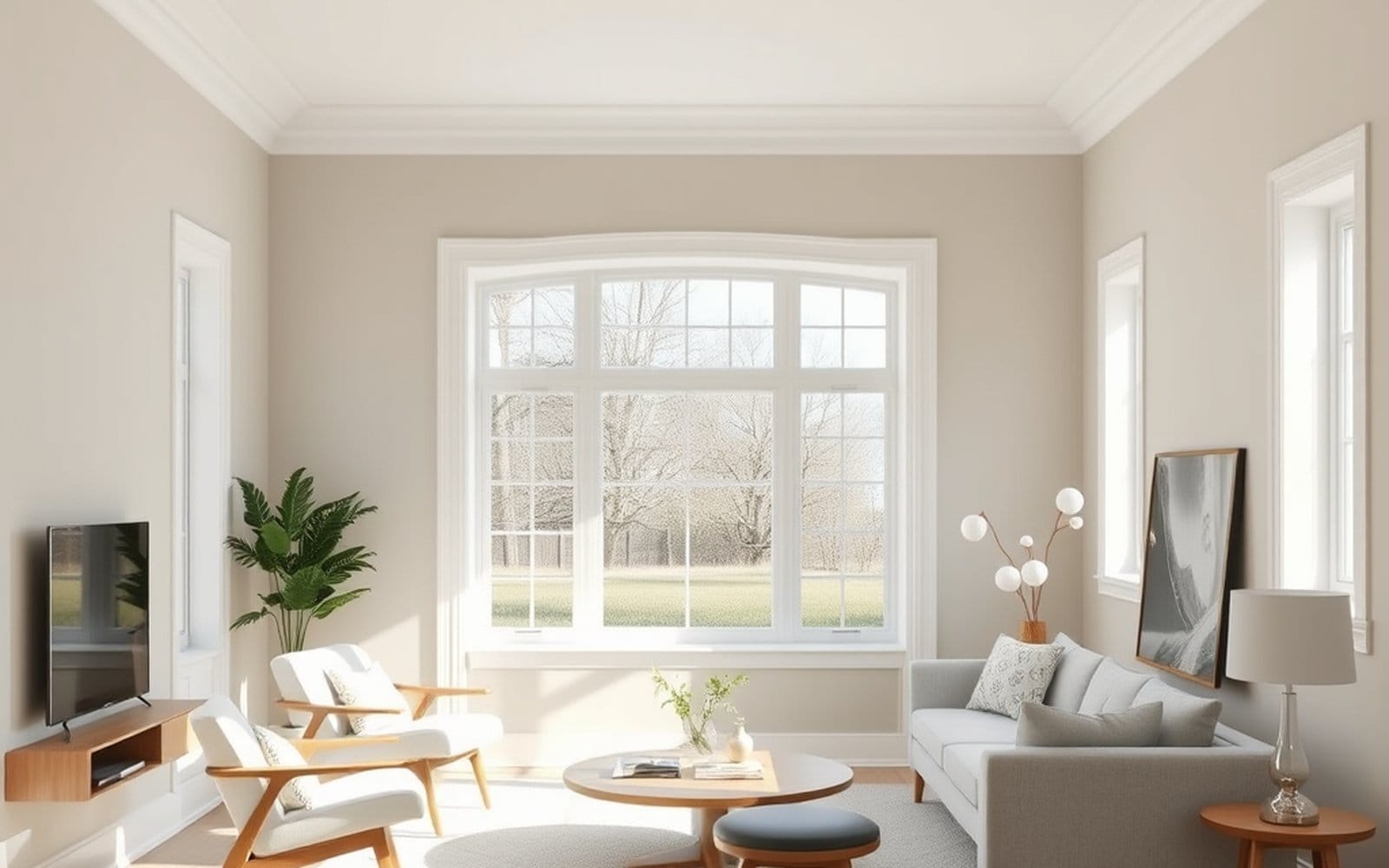
Height is the signature factor. A stairwell is defined by its vertical reach. In a two story home the stair wall can rise the full height of both floors, often 16 to 20 feet at the tallest point. That single tall wall holds a large amount of paintable area even though the stairwell footprint is small.
The angled gable wall is large. The wall that follows the slope of the stairs is a triangle or a tall trapezoid, and people routinely underestimate it. Its area is bigger than it looks from the floor because the top corner is so far up. This raw, tall wall area is what makes stairwells paint hungry.
Access affects application, not volume. Reaching the high sections needs ladders, a stair scaffold, or an extension pole, which makes the job harder and slower. But access does not change how many gallons you buy. The paint quantity is purely about square footage, so do not let the difficulty of reaching the top trick you into miscounting area.
How to measure the paintable area
Break the stairwell into shapes. Most stairwells are a combination of one tall rectangular wall, one sloped gable wall, and the upper landing walls. Measure each piece, then add them.
The tall straight wall: width times the full height. If the wall is 10 feet wide and rises 17 feet to the upper ceiling, that is 170 square feet from one wall alone.
The angled gable wall: for a triangular section, area is one half times base times height. For the common case where the wall is part rectangle and part triangle following the stair slope, measure it as a trapezoid: average the short side height and the tall side height, then multiply by the width. A gable wall 10 feet wide that is 9 feet tall at the bottom of the run and 17 feet at the top averages 13 feet, so 10 times 13 is 130 square feet.
The landing: the upper landing has its own short walls, usually a few sections totaling 60 to 120 square feet. Measure perimeter times height for the landing as you would a small hallway.
Subtract openings and add the ceiling: remove any windows on the tall wall, often a tall stairwell window worth 15 to 30 square feet, and measure the small landing ceiling separately as length times width.
Real coverage math
A gallon covers about 350 square feet on smooth, primed drywall in one coat, the baseline our how much does a gallon of paint cover guide uses. Start there and adjust down for real conditions.
Stairwell walls are often older and uneven. They may be lightly textured, previously a different color, or porous where they have been patched after years of furniture moving past. Plan for closer to 300 square feet per gallon, and less on heavy texture or a bold color change.
Divide, then multiply by coats. Add up all your stairwell wall pieces, divide by your realistic coverage rate, then multiply by coats. The tall total matters more than the small floor area, so trust the square footage you measured up the wall, not your eye.
How many coats you actually need
Two coats is standard for a stairwell. Because the tall wall catches raking light from windows and fixtures, an uneven single coat shows badly. Two coats give the even hide a prominent feature wall needs.
Prime large patched or color change areas. If the stair wall was a dark color or has big repaired sections, prime first so your two finish coats look uniform from floor to ceiling. Our how many coats of paint do I need guide explains when the height and lighting of a stairwell justify a careful third coat on the most visible wall.
A worked example for a real stairwell
Take an open two story stairwell with one tall wall 10 feet wide rising 17 feet, a sloped gable wall 10 feet wide averaging 13 feet, and a landing with about 90 square feet of wall. Here is the arithmetic.
Tall straight wall: 10 feet wide times 17 feet tall equals 170 square feet.
Sloped gable wall: 10 feet wide times the 13 foot average height equals 130 square feet.
Landing walls: 90 square feet as measured.
Subtract the stair window: one tall window at about 25 square feet comes off the straight wall. So gross wall is 170 plus 130 plus 90, which is 390, minus 25, leaving 365 square feet of paintable wall.
Apply coverage and coats: at 300 square feet per gallon, one coat is 365 divided by 300, which is 1.22 gallons. Two coats is 2.44 gallons. Round up to 3 gallons of wall paint for a tall stairwell like this.
Ceiling: the small landing ceiling, say 5 by 8 or 40 square feet, needs only a quart for two coats.
Total: about 3 gallons of wall paint, 1 quart of ceiling paint, and 1 quart of trim enamel for the handrail wall trim and landing baseboard. A shorter single story stair run would come in closer to 1.5 to 2 gallons.
Do not forget primer, trim, and ceiling
Primer matters on tall feature walls. The big stair wall is the most visible surface in the area, so any uneven patching or color change shows. Budget about 1 gallon of primer for a full two story wall, and check our how much primer do I need guide to decide between spot and full priming.
Trim is modest but present. Stairwells have baseboard along the landing, the skirt board following the stair stringer, and any window casing. One quart of trim enamel usually covers it for two coats.
The landing ceiling is small and separate. Use ceiling paint and keep its quart off the wall total. The main stair area often has no flat ceiling at all within reach, just the tall walls meeting the upstairs ceiling.
Buy about 10 percent extra
Add roughly 10 percent, and round generously. Stairwells are the worst place to run short, because setting the ladders and scaffold back up for a final touch up is a real hassle. If your math says 2.4 gallons, buy 3 and keep a labeled reserve. The extra gallon costs far less than a second high access session.
Label the leftover by location. A stairwell shares walls and sightlines with the hallway and entry, so a clearly marked stair can prevents a color mixup on later touch ups.
Tying paint quantity to cost
Gallons anchor materials, height drives labor. Your 2 to 3 gallons set the materials floor, but stairwells carry a labor premium for the ladders, scaffold, and slow high work. So the finished quote rises faster than the paint count alone suggests. For the full materials plus labor breakdown, see our cost to paint a stairwell guide, and for scheduling the high access work, our how long it takes to paint a stairwell piece.
Other rooms scale the same way. Our how much paint for a room hub gathers the per room quantity guides so you can size the connected hallway and entry using the same break it into shapes method you used here.
Common mistakes that waste stairwell paint
Eyeballing the tall wall instead of measuring it. The top of a stair wall is far from the floor, and the eye foreshortens it badly. People guess low and underbuy. Always measure the real heights, the short side and the tall side, and compute the area as a trapezoid or triangle rather than guessing.
Letting access difficulty distort the count. Because the high sections are hard to reach, some people assume they need less paint up there, or they simply stop measuring at ladder height. The square footage is the same whether it is easy or hard to reach. Count every foot of wall, then plan the access separately.
Running short at the worst possible time. A stairwell is the one room where a mid job supply run means tearing down and rebuilding scaffold. Underbuying here costs the most in time. This is the room to round up most generously.
Ignoring the landing as its own small room. The upper landing has its own walls, ceiling, and trim that are easy to forget when you are focused on the dramatic tall wall. Measure it as a small hallway and add it to your total.
A quick formula you can reuse
The method in one line. Add up each wall piece as its own shape, rectangle for straight walls and trapezoid or triangle for the sloped gable, divide the total by 300, multiply by coats, then add 10 percent. The only twist versus a normal room is breaking the tall wall into shapes.
Worked the fast way: tall wall 10 by 17 is 170, sloped gable 10 wide averaging 13 is 130, landing walls 90, minus a 25 square foot window, totals 365. Divided by 300 is about 1.2 gallons per coat. Times 2 coats is 2.4 gallons. Plus 10 percent rounds to a clean 3 gallon buy.
Keep the shape sketch. A simple sketch with each wall piece and its dimensions lets you recompute for a color change without re measuring up the ladder, and it gives the calculator a clean set of numbers to total.
How stairwell layout changes the totals
A closed stairwell with walls on both sides roughly doubles the tall wall area. An open stairwell typically has one big feature wall and a railing on the other side. A closed, boxed in stairwell has full height walls on both sides, so your tall wall measurement happens twice. Confirm which type you have before you settle on gallons.
A three story or split level run scales straight up. If the stairwell serves three floors, the tallest wall can exceed 25 feet, and the gallon count climbs in proportion. Measure the true top height even when it means estimating from a fixed point, because guessing low on a 25 foot wall can leave you a full gallon short.
A switchback stair adds a mid landing wall. Stairs that turn back on themselves have an intermediate landing with its own short walls. Measure that mid landing the same way you measure the upper one, as a small set of perimeter times height sections, and fold it into the total.
Frequently asked questions
How many gallons of paint for a two story stairwell?
A two story stairwell often needs 2 to 3 gallons of wall paint for two coats because of the tall straight wall and sloped gable wall. Add a quart of ceiling paint for the landing and a quart of trim enamel. Single story runs use closer to 1.5 to 2 gallons.
How do I measure the angled stairwell wall?
Treat the sloped section as a trapezoid. Measure the short height at the bottom of the stair run and the tall height at the top, average the two, then multiply by the wall width. For a pure triangle, use one half times base times height instead.
Does the height of a stairwell change how much paint I need?
Yes, height is the main driver. The tall stair wall holds far more square footage than the small floor area suggests, so a stairwell uses more paint than a same footprint room with normal ceilings. Always measure the full vertical reach.
Does hard access mean I need more paint?
No. Access difficulty affects how you apply the paint, with ladders or scaffold, but not the volume. Paint quantity depends only on square footage. Measure the walls accurately and ignore the reach when counting gallons.
Do I need primer for a stairwell wall?
Prime when the tall wall has large patches, a previous dark color, or bare drywall, since the most visible wall in the home shows any unevenness. Plan about 1 gallon of primer for a full two story wall, or spot prime smaller repairs.
How much trim and ceiling paint for a stairwell?
Trim is modest, usually 1 quart of enamel for the landing baseboard, stair skirt board, and any window casing. The landing ceiling is small, often under 50 square feet, so a single quart of ceiling paint covers it for two coats.