In this article
Quick answer: Painting the exterior of a two story house usually takes somewhere around 18 to 29 gallons total for two coats, split roughly into 15 to 24 gallons for the siding body and 3 to 5 gallons for the trim, fascia, soffits, and doors. That is a planning range, not a fixed number. A second story roughly doubles the band of siding compared with a one story home of the same footprint, and exterior gallons swing hard with siding texture. Measure the actual walls, do the coverage math below, and buy about 10 percent extra for touch-ups.
The idea that decides your gallon count on any exterior is this: paint quantity is driven by siding area and siding texture, not by floor area. A two story home stacks two levels of living space, so it wraps roughly two bands of siding around the perimeter instead of one. That is the whole reason a two story exterior needs more paint than a one story home with the same footprint: there is simply more siding surface, top and bottom. This guide shows you how to size that taller wall, walks the coverage math, gives you a gallons table, works an example, and clears up a common confusion about the second story. For the dollars side, see our companion guide on the cost to paint a two story house exterior, and for the whole-home framework, start with our hub on how much paint for a house exterior. To turn gallons and hours into a real price, use the painting cost calculator or grab a free painting estimate.
What drives exterior gallons on a two story home
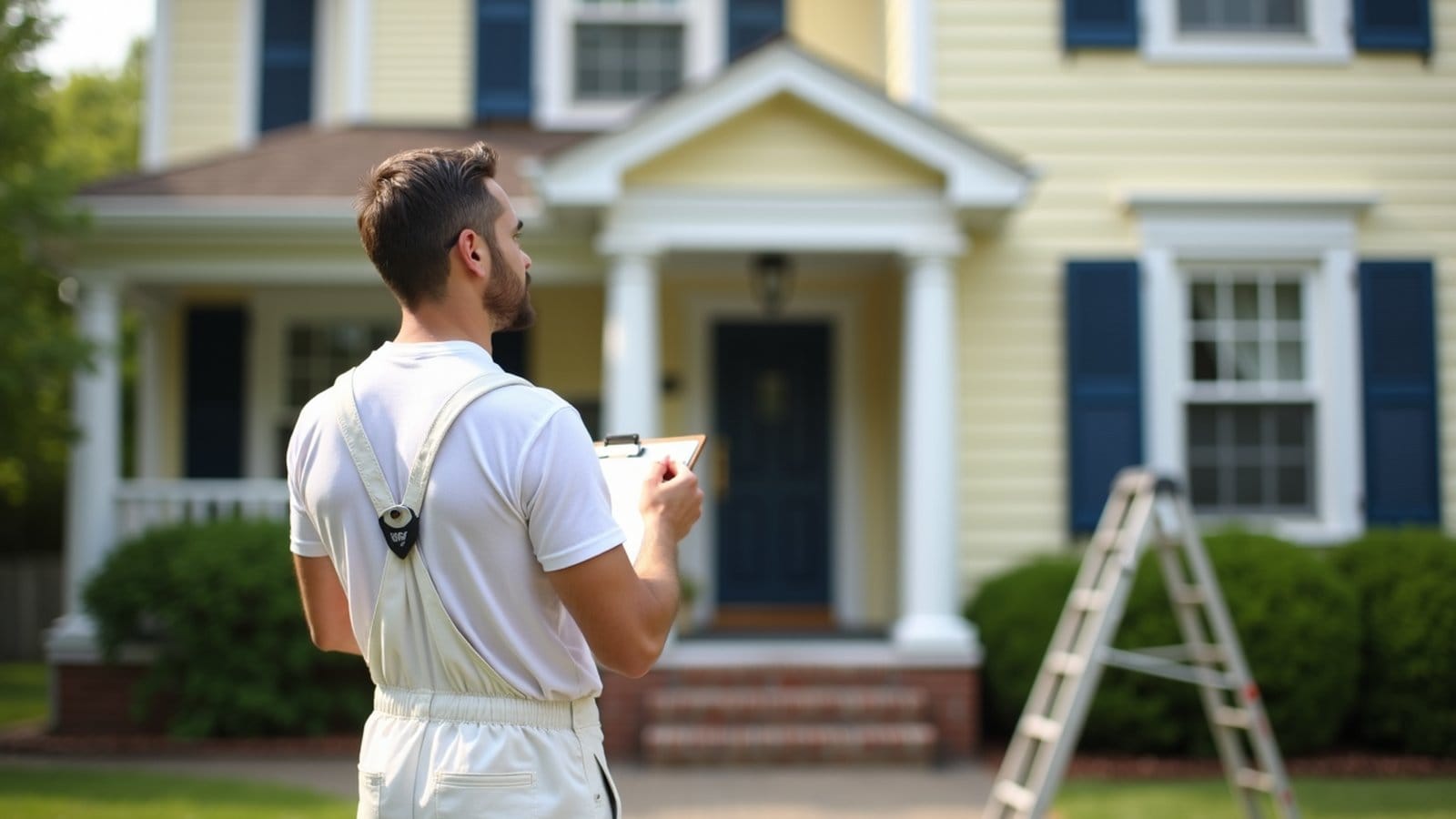
Exterior paint comes down to how much siding you have and how thirsty it is. The siding area, or body area, is the wall surface you roll and spray. You size it by measuring the perimeter and multiplying by the total wall height, then subtracting windows and doors. On a two story home that wall height is the full stack, often 18 to 20 feet from the foundation to the eave, so the same perimeter produces roughly twice the siding area of a single story home. That extra band is why the gallon count climbs.
The other half is texture, and it works the same on any exterior. Smooth lap siding or primed stucco covers near the ideal rate. Rough and porous surfaces fall off hard on the first coat: heavy-texture stucco, split-face block, rough sawn cedar, and bare brick can pull coverage down to 150 to 250 square feet per gallon as the surface soaks paint into its pits and grain. So two identical two story homes can need very different gallon counts purely because of the surface they wear. The coverage cornerstone behind all of this is our guide on how much a gallon of paint covers. For a clean comparison of what a single band looks like, see our sibling guide on how much paint for a one story house exterior.
The second story adds siding, not different math
This is the point people most often get wrong, so it is worth stating plainly. A second story does not change the coverage math per square foot. A square foot of smooth lap siding covers the same whether it is at ground level or 15 feet up. What the second story adds is a second band of siding area, and that extra area is what raises the gallon count. The paint does not behave differently up high.
What the second story genuinely does change is access. Reaching the upper band means ladders, extension poles, and sometimes staging or scaffolding, and that added reach affects the labor, the time, and the safety planning for the job, not the number of gallons. In other words, the height costs you effort and hours, but the gallons are still just a function of siding area and texture. Do not let the difficulty of reaching the top mislead you into buying extra paint. Buy for the area you measured, add your normal 10 percent cushion, and treat the access challenge as a labor question. For how reach translates into hours, our guide on painting production rates is the right reference, and the dollars land in the cost to paint a two story house exterior companion.
The coverage math
Exterior gallons come from the same formula everywhere: siding area, divided by the coverage rate, multiplied by the number of coats. On smooth lap siding or primed stucco, a gallon of quality exterior paint covers roughly 300 to 350 square feet per coat. On rough or porous surfaces the first coat can drop to 150 to 250 square feet per gallon, though the second coat goes further because the first has sealed the surface. Most exteriors are two coats, especially over a color change or weathered, chalky paint, and you can sometimes use one coat over sound, clean, same-color siding. Our guide on how many coats of paint you need covers when one is genuinely enough.
Bare wood and fresh masonry need primer first, which is its own coat with its own coverage, so size it separately with our guide on how much primer you need. Trim, fascia, soffits, and doors are figured on their own too, since they use a different product and slower application. On a two story home there is often more fascia and soffit to reach along the upper roofline, so the trim bucket tends to run a little larger than on a single story.
Gallons for a two story exterior
The table below splits the exterior into the buckets you buy paint for. The siding body is figured at two coats across both bands, and the trim, fascia, soffits, and doors are grouped as their own bucket. These are typical planning ranges for two coats. Your real numbers depend heavily on siding texture and how much detail the home carries.
| Surface (two story exterior) | Coats | Typical gallons |
|---|---|---|
| Siding body | 2 coats | 15 to 24 gallons |
| Trim, fascia, and soffits | 2 coats | 3 to 4 gallons |
| Doors | 2 coats | About 1 gallon |
| Whole exterior total | 2 coats | 18 to 29 gallons |
Read the total as a band, not a target. A modest two story with smooth lap siding lands near the bottom. A large two story with rough stucco or masonry, plus a lot of fascia and soffit, pushes toward the top or beyond. Compare the single-band version in our sibling guide on how much paint for a one story house exterior to see how much the second story adds.
A worked example
Walk through a realistic two story home. Suppose the perimeter measures about 160 linear feet and the total wall height, ground to eave, is 18 feet. That gives a gross wall area of 160 times 18, or 2880 square feet. Subtract roughly 15 percent for windows and doors, and you land near 2450 square feet of actual siding body, nearly double what a one story home of similar footprint would show.
For smooth lap siding at two coats and 325 square feet per gallon, that is 2450 divided by 325, times 2, or about 15 gallons of body paint. Switch the surface to rough stucco, with a first coat at 200 square feet per gallon and a second at 325, and the same wall needs roughly 12.3 plus 7.5, about 20 gallons. Same house, but the rough surface added five gallons on the body alone.
Add the trim, fascia, and soffits, which on a two story home run about 3 to 4 gallons across two coats, plus about a gallon for the doors. On the smooth version you land near 15 plus 4, about 19 gallons total. On the rough stucco version you land near 20 plus 5, about 25 gallons. Then add roughly 10 percent for touch-ups and round up to full cans. Remember the height did not change any of these coverage numbers, only the effort it takes to apply them.
What changes how much you need
- Siding texture and porosity. The biggest driver on any exterior. Smooth lap siding covers at 300 to 350 square feet per gallon, while rough stucco, split-face block, rough cedar, and bare brick can drop the first coat to 150 to 250. Identify your surface before counting gallons.
- Siding type. Fiber cement, vinyl, wood lap, stucco, and masonry all behave differently. Masonry and rough wood are the thirstiest, while smooth previously painted siding is the most economical.
- Color change and coats. Sound same-color paint may take a single coat, but a color change or weathered paint needs two. See how many coats you need before assuming one will do.
- Primer. Bare wood, fresh stucco, and raw masonry need primer first, which is its own coat. Our guide on how much primer you need helps size it separately.
- Access, not gallons. The second story raises the labor, time, and safety planning through ladders and staging, but it does not change the coverage rate or the gallon count. Size paint from the area, and treat reach as a labor question via production rates.
Turning gallons into a budget
Once you know the gallon count, the budget follows, but on a two story exterior the split between paint and labor tilts even further toward labor because of the access. Multiply gallons by your paint price, then account for the prep and the reach that make up the larger share of the job. Always buy about 10 percent extra for matching touch-up stock, and record the exact product and color. To turn siding area and gallons into a real price, use the painting cost calculator or start from a free painting estimate. For the full dollars breakdown of this exact job, see our companion guide on the cost to paint a two story house exterior, and our walkthrough on how to estimate exterior painting ties the gallons, the prep, the access, and the price together.
Frequently asked questions
How many gallons of paint for a two story house exterior?
Most two story exteriors take about 18 to 29 gallons total for two coats, with roughly 15 to 24 gallons for the siding body and 3 to 5 for trim, fascia, and doors. That is a planning range. Rough or porous siding pushes it higher, so measure your actual walls and buy about 10 percent extra.
Does a two story house need twice as much paint as a one story?
Roughly, for the same footprint, because a second story adds a second band of siding and about doubles the body area. It is not always exactly double, since trim and doors do not scale the same way and rooflines differ, but the siding body is the main reason a two story exterior needs meaningfully more paint than a one story home.
Does the second story change the coverage math?
No. A square foot of siding covers the same whether it is at ground level or 15 feet up, so the coverage rate per square foot does not change. The second story simply adds siding area, which raises the gallon count. What it really changes is access, which affects labor, time, and safety, not the number of gallons.
Why does siding texture matter so much?
Because rough and porous surfaces swallow paint on the first coat. Smooth lap siding covers at about 300 to 350 square feet per gallon, but heavy stucco, split-face block, rough cedar, or bare brick can drop the first coat to 150 to 250. Texture, not the number of stories alone, is often the biggest reason two homes need different gallon counts.
How do I estimate my siding area on a two story home?
Measure the perimeter and multiply by the full wall height, ground to eave, which on a two story home is often 18 to 20 feet. Subtract roughly 10 to 15 percent for windows and doors. That siding area, divided by the coverage rate and multiplied by the coats, gives your body gallons. The taller wall is why the number is larger than a one story home.
How much extra paint should I buy?
Buy about 10 percent more than the math says. It covers thin spots, an extra pass where weather hits hardest, and leaves matching touch-up stock for future repairs. Size the paint from the measured area, not from how hard the upper story is to reach, and keep the leftover sealed and labeled.
Sizing the paint for a two story exterior comes down to measuring both bands of siding, judging the texture, doing the coverage math, and remembering that height adds labor, not gallons. When you are ready to price the job, use the painting cost calculator or start a free painting estimate, compare the dollars in our cost to paint a two story house exterior guide, and see the single-band version in how much paint for a one story house exterior.