In this article
- The signature point: height and access set the price
- Cost by scope
- Labor versus materials on a two-story exterior
- Siding material still matters
- A worked example: how access changes the labor
- DIY versus hiring a pro: the safety reality
- What else moves a two-story exterior price
- How to budget your two-story exterior
- Frequently asked questions
- How much does it cost to paint a two story house exterior?
- Why does a two-story exterior cost more per square foot than a one-story?
- Is painting a two-story house exterior yourself dangerous?
- What adds the most to a two-story exterior quote?
- Does siding material change the price on a two-story home?
- How can I keep a two-story exterior repaint affordable?
Quick answer: A two-story exterior costs more per square foot than a one-story home of the same footprint, and the reason is height, not extra wall. As a broad, verify-locally range, a full two-story exterior repaint commonly runs roughly 5,000 to 15,000 dollars, and larger or heavily weathered homes can climb beyond that. The premium comes from access: tall ladders and scaffolding, slower and safer work high off the ground, careful cutting in at gable peaks and dormers, and the setup and teardown that height demands. Siding material, prep, and the number of colors move it further. Get three local quotes and price your own walls before you trust any single figure, because access surcharges vary a lot by house.
The most misunderstood thing about pricing a two-story exterior is that the second story does not simply double the first. The added wall area is real, but the bigger driver is that every square foot up high is slower, riskier, and more equipment-dependent to paint than the same square foot at ground level. This guide explains that height and access premium, which is the signature teaching point, then breaks the job down by scope, splits labor from materials, and shows a worked example of how access reshapes the labor. It sits under our cost to paint a house hub, and its direct counterpart is the cost to paint a one story house exterior guide, which shows the low-access baseline this job is measured against. Before you call a painter, run your walls through the painting cost calculator for a grounded starting figure.
The signature point: height and access set the price
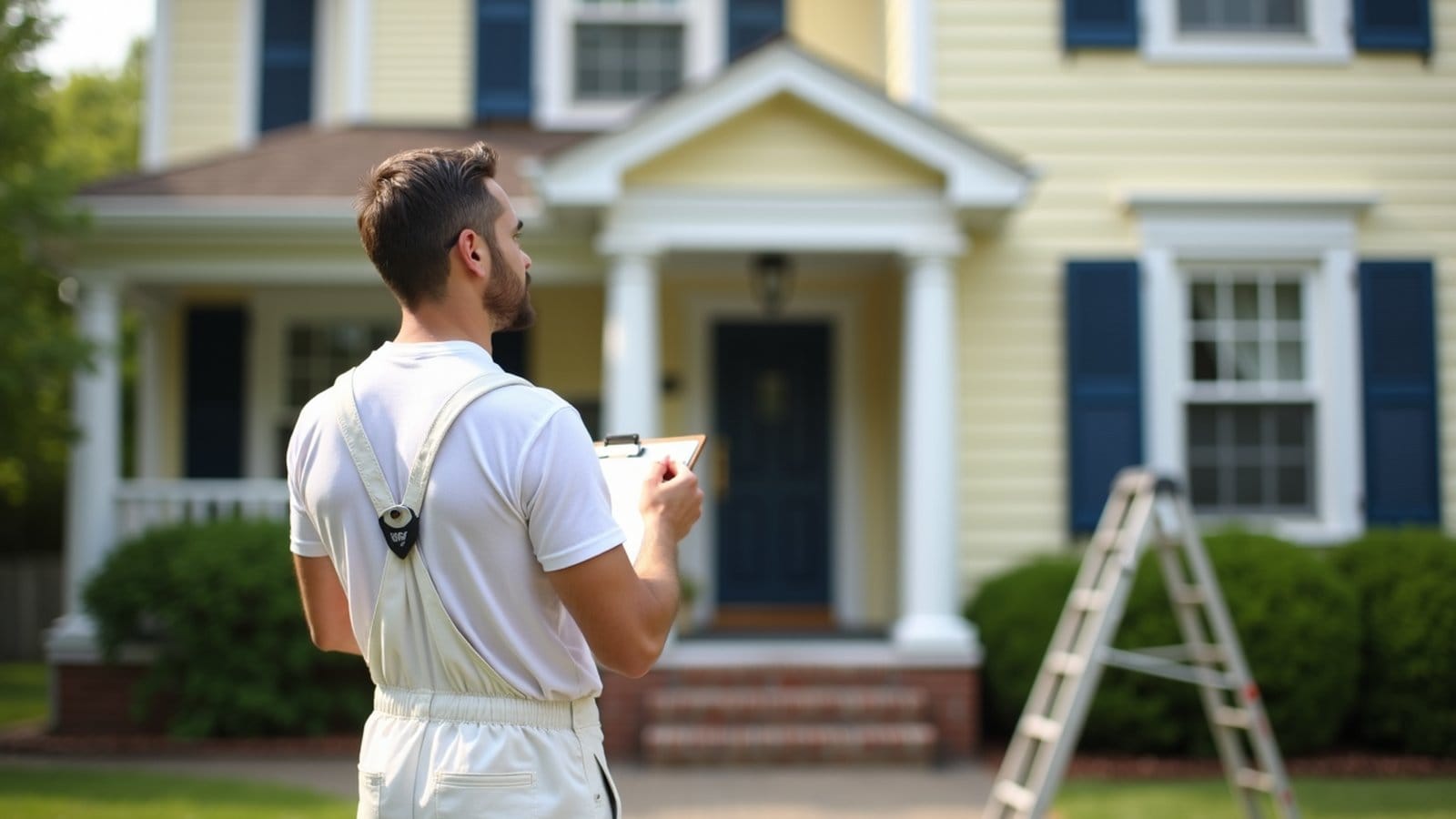
On a two-story home, the walls above the first floor cannot be reached from the ground. To paint them safely, a crew uses tall extension ladders, and often scaffolding or aerial equipment, which changes everything about how the work goes. Setting up and repositioning that access equipment takes time. Working from it is slower, because a painter high on a ladder moves deliberately, keeps three points of contact, and cannot cover ground the way someone standing on the lawn can. Cutting in cleanly along a soffit or around an upper window is far more painstaking twenty feet up than at eye level. And the crew must work safely at every moment, which is right and necessary but inherently slower than ground work.
All of that is labor, and labor is the majority of an exterior bill, so the height premium lands squarely on your total. This is why a two-story home costs more per square foot than a one-story of the same footprint: it is not that there is proportionally more paint, it is that the upper reaches are expensive to access. Gable peaks, dormers, second-story eaves, and tall entry walls are the classic access-premium zones, each demanding slow, careful, elevated work. Our how to estimate exterior painting guide shows how estimators price that reach into a job.
Cost by scope
The total depends on how much of the two-story exterior you are painting and its condition, with the access premium threaded through all of it. The ranges below are typical and vary by region, siding, prep, height, and colors, so treat them as a frame rather than a quote.
| Two-story exterior scope | Typical range | What mostly moves it |
|---|---|---|
| Siding and body only | 3,500 to 9,000 | Wall height, access equipment, coats |
| Body plus trim and one accent | 4,500 to 11,000 | Upper trim, gables, color changes |
| Full exterior (body, trim, soffits, fascia, doors) | 5,000 to 15,000 | Prep, height, detail, number of colors |
| Heavy-prep or complex repaint | 7,000 to 20,000 | Scaffolding, scraping, repairs, tall peaks |
Compare these to the one-story ranges in our companion guide and the access premium is plain: the same scope costs more once the walls rise, because the upper portion carries a labor surcharge that ground-level work never does. The taller and more complex the elevations, the more that surcharge grows.
Labor versus materials on a two-story exterior
Exterior work is labor-heavy to begin with, and height pushes the labor share even higher. The paint, primer, and caulk are the minority of the bill. The majority goes to labor, and on a two-story home a meaningful chunk of that labor is the access itself: erecting and moving ladders and scaffolding, working slowly and safely at height, and spending extra care on elevated cut-in. Two homes with the same wall area can differ substantially in price simply because one stacks that area high and the other spreads it low.
Prep condition then stacks on top. A weathered two-story home with peeling or chalking paint needs scraping, sanding, priming, and caulking, and doing that work at height is slower and costlier than the same prep at ground level. This double effect, height plus prep, is why heavily weathered tall homes reach the upper end of the ranges. Our guide on how much painters charge to paint a house exterior explains how crews build those access and prep hours into a price you can compare.
Siding material still matters
As with any exterior, the siding changes the number. Different surfaces paint differently: smooth ones cover quickly and use less paint, while rough, porous, or textured surfaces need more paint and more careful application to coat fully. Some materials require specific prep or priming, and any peeling or damage adds repair time. On a two-story home this interacts with height, because doing more involved prep or coating a demanding surface high off the ground compounds the access premium. To estimate how much paint the walls will actually take, our how much paint for a house exterior guide walks through the coverage math for a full house.
Keeping a two-story exterior painted and sealed also protects the shell and its performance over time. The U.S. Department of Energy’s material on home exteriors and weatherization background at https://www.energy.gov gives useful context on why maintaining the outer surface pays off beyond appearance.
A worked example: how access changes the labor
Take a two-story home with roughly 2,400 square feet of paintable wall area. On paper that is a moderate amount of surface, but where the surface sits changes the labor completely. The lower half, the first-story walls, paints much like a one-story home: reachable from the ground and short ladders, fast and steady. The upper half is a different job. To paint the second-story siding, upper windows, soffits, fascia, and any gable peaks, the crew sets up tall ladders or scaffolding, repositions it repeatedly around the house, and works slowly and carefully at height.
The result is that the upper 1,200 square feet can take substantially more crew time than the lower 1,200, even though the paint and the square footage match. Add a steep gable, a two-story entry wall, or dormers, and the elevated portion grows slower still. That imbalance, cheap lower half and expensive upper half, is exactly why a two-story exterior costs more per square foot than a one-story of the same footprint, where every square foot enjoys the easy ground-level rate. Our cost to paint a one story house exterior guide is the low-access baseline to compare against, and our how long it takes to paint a house exterior guide shows how height stretches the schedule too.
DIY versus hiring a pro: the safety reality
This is the section to read most carefully. Painting a two-story exterior yourself means working high on ladders around the full perimeter, cutting in at gable peaks, and reaching second-story eaves and dormers, and that is genuinely dangerous. Falls from height are a leading cause of serious injury in home and construction work, and a ladder that shifts on uneven ground or a moment of overreach twenty feet up can end badly. Unlike interior work or a one-story exterior, a two-story exterior is not a low-stakes DIY project. The height is exactly where the risk lives.
Because of that, a two-story exterior is the clearest case in this whole series for hiring a professional. Pros own the ladders and scaffolding, are trained to work at height safely, and can do in days what would take a homeowner risky weeks. The savings from doing it yourself are mostly labor, and on a two-story home those very hours are the ones that put you up a tall ladder, so the trade is savings against a real fall risk. For guidance on working safely at height and the hazards of ladder and elevated work, the U.S. Occupational Safety and Health Administration publishes fall-protection and ladder-safety material at https://www.osha.gov. If you do hire, vet the crew, ask for references, and confirm they carry insurance for height work before any ladder goes up.
What else moves a two-story exterior price
Beyond height and prep, several factors swing the total, and knowing them helps you read a quote.
- Number and steepness of gables and dormers. Every peak and dormer is a slow, elevated cut-in zone that adds access-heavy labor.
- Wall height and terrain. Taller elevations and sloped or uneven ground around the house make ladder and scaffold setup harder and slower.
- Prep and scraping. Peeling or chalking paint high up is both necessary and costly to address, since the work happens at height.
- Number of colors. Body, trim, and accent colors multiply cutting in, and doing that up high is slower than at ground level.
- Soffits and fascia detail. Wide soffits and long fascia runs at the roofline add careful elevated brush work.
Timing matters too. Painting in the right season, when temperature and humidity suit the paint, avoids failures that would force a costly return to those hard-to-reach heights. Our guide on the best time of year to paint a house exterior helps you pick a window so the two-story repaint lasts and you are not back up the ladder sooner than you should be.
How to budget your two-story exterior
To land on a trustworthy number, measure your paintable wall area rather than guessing from the floor size, or let the calculator estimate it, and remember that the upper portion carries a labor premium the lower portion does not. Decide your scope, factor your real conditions of siding and prep, and account honestly for the access complexity of your gables, dormers, and wall height. Then get three local quotes and compare them against your own estimate so you can spot an outlier. A two-story exterior costs more per square foot than a one-story because the height is expensive to reach safely, and that access reality, not paint, is what you are budgeting for. Start with the painting cost calculator, then generate a shareable figure with our free painting estimate tool before the first painter visits.
Frequently asked questions
How much does it cost to paint a two story house exterior?
As a broad, verify-locally range, a full two-story exterior repaint commonly runs around 5,000 to 15,000 dollars, and larger or heavily weathered homes can climb beyond that. The premium over a one-story home comes from access: tall ladders and scaffolding, slower and safer work at height, and careful cutting in at gables and dormers. Siding, prep, and colors move it further. Measure your walls, factor the height complexity, and get three local quotes before trusting any single figure.
Why does a two-story exterior cost more per square foot than a one-story?
Because height, not extra wall, drives the difference. The upper walls cannot be reached from the ground, so crews use tall ladders and scaffolding, work more slowly and carefully for safety, spend time setting up and moving access equipment, and take longer to cut in at peaks and dormers. All of that is labor, and labor is the majority of an exterior bill, so the elevated portion carries a surcharge that the same square footage at ground level never does.
Is painting a two-story house exterior yourself dangerous?
Yes, meaningfully so. It means working high on ladders around the full perimeter, cutting in at gable peaks, and reaching second-story eaves, and falls from height are a leading cause of serious injury. A ladder shifting on uneven ground or a moment of overreach can end badly. This is the clearest case in house painting for hiring a professional, since the savings from DIY are mostly the very hours that put you up a tall ladder. See OSHA’s ladder and fall-protection guidance before attempting it.
What adds the most to a two-story exterior quote?
Access complexity and prep. Steep or numerous gables and dormers, tall walls, and uneven terrain all make elevated work slower and equipment setup harder, and that access-heavy labor is the biggest swing. On top of that, peeling or chalking paint high up must be scraped and primed at height, which is costlier than the same prep at ground level. Since labor dominates the bill, these height-related hours move the total far more than the paint does.
Does siding material change the price on a two-story home?
Yes. Smooth surfaces cover quickly and use less paint, while rough, porous, or textured ones need more paint and more careful application, and some materials require specific prep or priming. On a two-story home this compounds with height, because doing more involved prep or coating a demanding surface high off the ground adds to the access premium. So the same siding is costlier to handle on the upper walls than it would be at ground level.
How can I keep a two-story exterior repaint affordable?
Stay ahead of prep so the walls never weather badly, keep colors simple to reduce elevated cutting in, and paint in the right season so the finish lasts and you avoid a costly return to height for reworks. Get multiple quotes, since access surcharges vary a lot between crews, and confirm each painter is insured for height work. Measure your actual wall area and compare bids against your own estimate so you can judge whether the access premium in a quote is reasonable.
Need the timeline as well as the price? See how long it takes to paint a two story house exterior.
Pricing the exterior as a pro? See how much to charge to paint a two story house exterior.
Need the gallon count for the exterior? See how much paint for a two story house exterior.