In this article
- The signature point: height and access add the days
- Working time versus calendar time, magnified by height
- Time by phase
- Weather and access stack up on the calendar
- A day-by-day example
- DIY versus pro pace: the safety reality
- What else speeds up or slows down the job
- How to plan your two-story exterior timeline
- Frequently asked questions
- How long does it take to paint a two story house exterior?
- Why does a two-story exterior take longer than a one-story?
- Is painting a two-story house exterior yourself dangerous?
- How much does weather add to the timeline?
- What adds the most working time to a two-story exterior?
- How can I keep a two-story repaint on schedule?
Quick answer: A two-story exterior takes longer to paint than a one-story home of the same footprint, and the reason is height, not extra wall. As a broad, verify-locally range, a professional crew usually spends roughly 4 to 8 working days on a full two-story exterior repaint, and larger or heavily weathered homes can run beyond that. Those are working days. The calendar can stretch further, because exterior paint needs dry days above a minimum temperature, so rain and cold pause the job, and a tall house loses even more time to ladder and scaffold setup and repositioning. Siding, prep, and the number of colors move it too. Ask your painter for a weather-aware, access-aware schedule before you plan around any figure.
The most misunderstood thing about the timeline of a two-story exterior is that the second story does not simply double the first. The added wall area is real, but the bigger driver is that every square foot up high is slower and more equipment-dependent to paint than the same square foot at ground level. This guide explains that height and access premium, which is the signature teaching point, then separates working time from calendar time, breaks the job into phases, and shows a day-by-day example. It sits under our how long to paint a house exterior hub, and its direct counterpart is the how long to paint a one story house exterior guide, which shows the low-access baseline this job is measured against. To see how the timeline becomes dollars, our cost to paint a two story house exterior twin runs the same house through the money side. Before you call a painter, map your walls in the painting cost calculator.
The signature point: height and access add the days
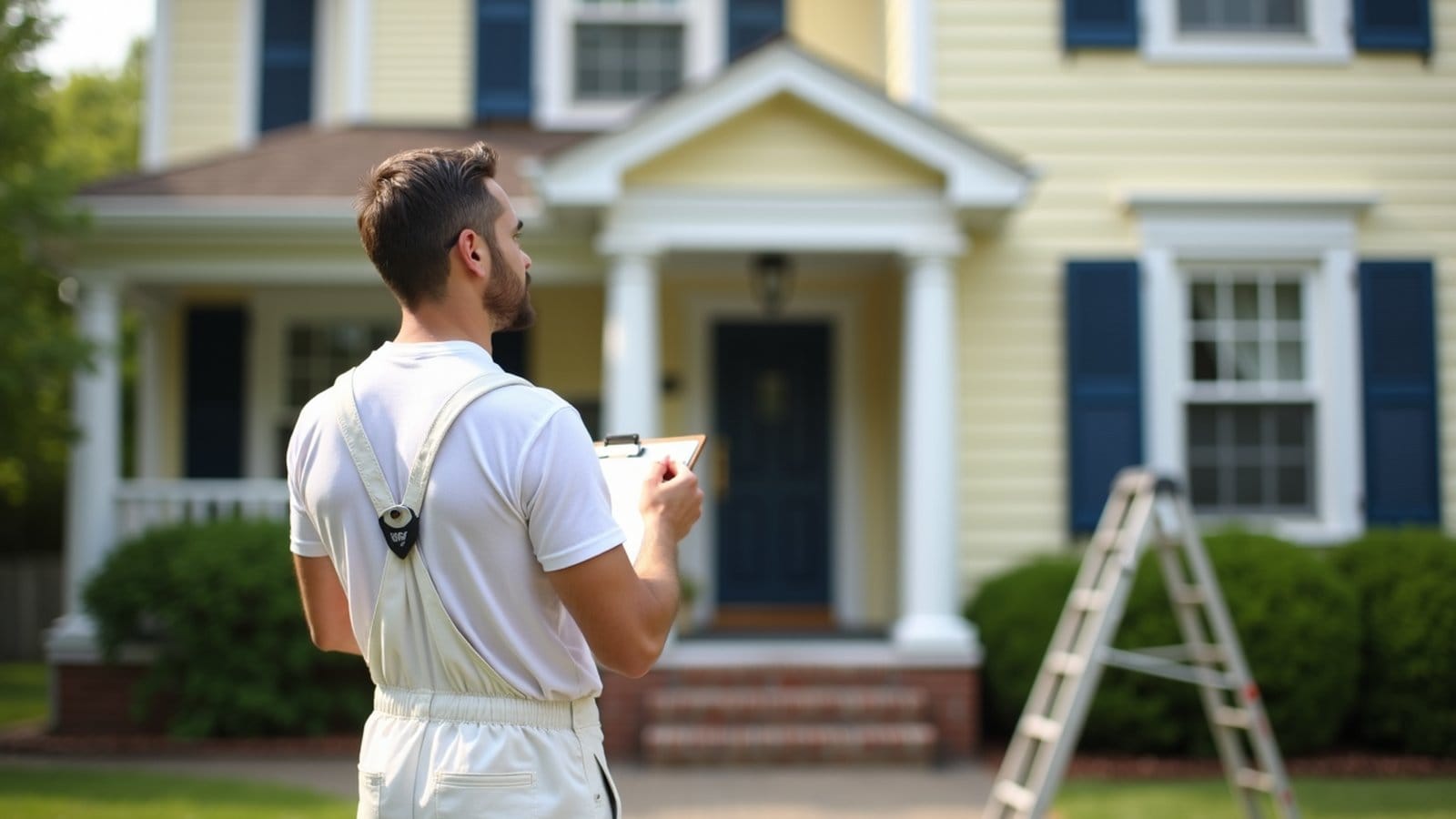
On a two-story home, the walls above the first floor cannot be reached from the ground. To paint them safely, a crew uses tall extension ladders, and often scaffolding or aerial equipment, and that changes everything about how the work goes and how long it takes. Setting up and repositioning that access equipment takes time that a one-story job never spends. Working from it is slower, because a painter high on a ladder moves deliberately, keeps three points of contact, and cannot cover ground the way someone standing on the lawn can. Cutting in cleanly along a soffit or around an upper window is far more painstaking twenty feet up than at eye level.
All of that is labor, so the height premium lands squarely on your working days. This is why a two-story home takes more working time per square foot than a one-story of the same footprint: it is not that there is proportionally more paint, it is that the upper reaches are slow and equipment-heavy to access. Gable peaks, dormers, second-story eaves, and tall entry walls are the classic access-premium zones, each demanding slow, careful, elevated work. Our how to estimate exterior painting guide shows how estimators price that reach into a schedule and a bid.
Working time versus calendar time, magnified by height
The working-versus-calendar distinction matters on every exterior, but on a two-story home it is magnified from both ends. On the working side, the access setup and the slower pace at height add labor hours that a ground-level job avoids, so the working days themselves are longer. On the calendar side, weather still rules: exterior paint needs dry surfaces and temperatures above a minimum, so rain and cold pause the job entirely, and those idle days count even though no labor happens. A tall house therefore loses time twice, once to the extra access labor and again to the weather delays that any exterior faces.
The practical result is that a two-story exterior can occupy your property for a noticeably longer window than a one-story home of similar wall area, even though the paint and the square footage are comparable. Always ask a painter for a start date and an expected finish window that allows for both the access complexity and the weather, not just a labor estimate. Our painting production rates guide explains the square-feet-per-hour figures behind the working-day estimate, and why height slows them down.
Time by phase
The two-story exterior moves through the same phases as any exterior, but the access premium threads through every one of them. The ranges below are typical and vary by region, siding, prep, height, and weather, so treat them as a frame rather than a quote.
| Phase on a two-story exterior | Typical time | What mostly moves it |
|---|---|---|
| Wash and dry | Most of a day, plus drying | Height of walls, method, weather |
| Access setup and scrape or sand | 1 to 2 working days | Ladder and scaffold setup, how weathered the paint is |
| Caulk, prime, and mask | 1 day or more | Upper gaps and bare spots reached at height |
| First and second coats | 2 to 4 working days | Height, gables, dormers, colors, dry time |
| Full two-story exterior | 4 to 8 working days | Access complexity, prep, size, weather windows |
Compare these to the one-story ranges in our companion guide and the access premium is plain: the same scope takes more working days once the walls rise, because the upper portion carries a labor surcharge and a setup cost that ground-level work never does. The more complex the elevations, the larger the share of the day that goes on moving and securing access rather than painting.
Weather and access stack up on the calendar
Because a two-story exterior is slow to access and dependent on dry, mild weather, the calendar can run well past the working days. Each coat needs dry conditions to go on and cure, and a rainy stretch pauses the job just as it would on a one-story home. But the tall house also loses time that the low one does not: the crew spends part of each working day erecting, moving, and taking down access equipment, and works more slowly high off the ground. Put the weather delays and the access setup together and a two-story repaint occupies your property longer than the raw labor suggests. Planning for a dry, mild window in your season keeps the weather side in check, but you cannot plan away the access time, which is baked into a tall house. For lead-safe practices during prep on older homes, which add time when done properly, the U.S. Environmental Protection Agency’s guidance at https://www.epa.gov/lead is a useful reference before scraping or sanding pre-1978 surfaces at height.
A day-by-day example
Take a two-person crew painting the full exterior of a two-story home. Day one goes to washing the walls, which itself takes longer because the upper reaches need a ladder or extended equipment, then letting them dry. Day two brings access setup and the scrape and sand, with much of the time spent positioning and repositioning ladders to reach the second-story siding and eaves. Day three finishes prep at height, caulking and priming the upper gaps and bare spots and masking the windows. Days four and five carry the first coat around the house, with the lower half moving quickly and the upper half slow and deliberate. Day six brings second coats, gables, dormers, soffits, fascia, and a careful final walk-around. That is roughly five to six working days on a moderate two-story home.
Now add a wet week and the calendar balloons: two rained-out days push the same five or six working days across a week and a half or more. Add a steep gable, a tall entry wall, or heavy weathering up high, and the elevated portion grows slower still. Same paint, same square footage as a one-story of equal wall area, very different working days and calendar, all because of height. Our how long to paint a one story house exterior guide is the low-access baseline to compare against, and our production rates guide shows how height cuts into the pace.
DIY versus pro pace: the safety reality
This is the section to read most carefully. Painting a two-story exterior yourself means working high on ladders around the full perimeter, cutting in at gable peaks, and reaching second-story eaves and dormers, and that is genuinely dangerous and slow for a solo homeowner. Falls from height are a leading cause of serious injury in home and construction work, and a ladder that shifts on uneven ground or a moment of overreach twenty feet up can end badly. Unlike a one-story exterior, a two-story exterior is not a low-stakes DIY project, and a homeowner working carefully and alone will move far slower than a trained crew, stretching a job that a pro measures in days into risky weeks.
Because of that, a two-story exterior is the clearest case in this whole series for hiring a professional. Pros own the ladders and scaffolding, are trained to work at height safely, and can do in days what would take a homeowner risky weeks. The time saved from doing it yourself is mostly labor, and on a two-story home those very hours are the ones that put you up a tall ladder, so the trade is elapsed time against a real fall risk. For guidance on working safely at height and the hazards of ladder and elevated work, the U.S. Occupational Safety and Health Administration publishes fall-protection and ladder-safety material at https://www.osha.gov. If you do hire, confirm the crew is insured for height work before any ladder goes up.
What else speeds up or slows down the job
Beyond height and weather, several factors swing the timeline, and knowing them helps you plan.
- Number and steepness of gables and dormers. Every peak and dormer is a slow, elevated cut-in zone that adds access-heavy working time.
- Wall height and terrain. Taller elevations and sloped or uneven ground make ladder and scaffold setup harder and slower.
- Prep and scraping. Peeling or chalking paint high up is both necessary and slow to address, since the work happens at height.
- Number of colors. Each additional colour adds another pass at height, and every pass means repositioning the access again before any cutting in starts.
- Crew size. More painters finish sooner, though height limits how much the work can parallelize compared with a one-story home.
Timing helps too. Painting in a dry, mild season window avoids failures that would force a costly and slow return to those hard-to-reach heights. Getting the weather right the first time is worth even more on a tall house, where a redo means setting up all that access equipment again.
How to plan your two-story exterior timeline
To land on a schedule you can trust, measure your paintable wall area rather than guessing from the floor size, or let the calculator estimate it, and remember that the upper portion carries a time premium the lower portion does not. Decide your scope, factor your real conditions of siding and prep, and account honestly for the access complexity of your gables, dormers, and wall height. Then ask each painter for both a working estimate and a calendar window that allows for weather and access setup. A two-story exterior takes more working days than a one-story because the height is slow and equipment-heavy to reach safely, and that access reality, plus weather, is what you are planning around. Start with the painting cost calculator, then generate a shareable figure with our free painting estimate tool before the first painter visits.
Frequently asked questions
How long does it take to paint a two story house exterior?
As a broad, verify-locally range, a professional crew usually spends about 4 to 8 working days on a full two-story exterior repaint, and larger or heavily weathered homes can run beyond that. The premium over a one-story home comes from access: tall ladders and scaffolding, slower and safer work at height, and setup that eats into each day. The calendar can stretch further because rain and cold pause the work. Ask your painter for a weather-aware, access-aware schedule, not just a labor estimate.
Why does a two-story exterior take longer than a one-story?
Because height, not extra wall, drives the difference. The upper walls cannot be reached from the ground, so crews use tall ladders and scaffolding, work more slowly and carefully for safety, spend time setting up and moving access equipment, and take longer to cut in at peaks and dormers. All of that is labor, so the elevated portion adds working days that the same square footage at ground level never would. Access, not paintable area alone, is what stretches the schedule.
Is painting a two-story house exterior yourself dangerous?
Yes, meaningfully so. It means working high on ladders around the full perimeter, cutting in at gable peaks, and reaching second-story eaves, and falls from height are a leading cause of serious injury. A ladder shifting on uneven ground or a moment of overreach can end badly, and a solo homeowner also works far slower than a trained crew. This is the clearest case in house painting for hiring a professional. See the U.S. Occupational Safety and Health Administration’s ladder and fall-protection guidance before attempting it.
How much does weather add to the timeline?
A lot, and it stacks with the access delay. Exterior paint needs dry surfaces and temperatures above a minimum, so rain and cold pause the job entirely, and those idle days count on your calendar. A two-story home loses time twice: once to weather like any exterior, and again to the ladder and scaffold setup that height demands. So the elapsed window can run well past the working days. Planning for a dry, mild season window keeps the weather side in check.
What adds the most working time to a two-story exterior?
Access complexity and prep. Gables, dormers and uneven ground each add setting up and taking down time before a brush moves, and that setup repeats every time the equipment is repositioned, and that access-heavy labor is the biggest swing. On top of that, peeling or chalking paint high up must be scraped and primed at height, which is slower than the same prep at ground level. Since the working days are driven by labor, these height-related hours stretch the schedule far more than the paint itself does.
How can I keep a two-story repaint on schedule?
Pick a dry, mild season window so weather does not pause the work, stay ahead of prep so the walls never weather badly, and keep colors simple to reduce elevated cutting in. Confirm each painter is insured for height work and ask for a finish window that allows for both weather and access setup. Getting the timing right the first time matters even more on a tall house, since a redo means setting up all that ladder and scaffold equipment again. Compare each painter’s schedule against your own estimate.