In this article
- The real answer: turnover drives the interval, not the calendar
- Short tenancy versus long tenancy
- What normal wear and tear tends to mean in practice
- The parts that fail first
- A workable default cycle
- Why standardising makes the interval cheap
- When to repaint mid-tenancy
- Document the condition every single time
- What to do next
- Frequently asked questions
- Is there a law that says how often a landlord must paint?
- Do I have to repaint between every tenant?
- Can I charge the tenant for repainting?
- Which parts of a rental need painting most often?
- Should every unit in my portfolio be the same colour?
- Is it worth repainting while a tenant is still living there?
There is no single universal repaint interval that applies everywhere. In most places the law does not say “repaint every X years,” so the honest answer is that the interval is set by turnover, not by a calendar. Most landlords end up repainting either at the end of a tenancy or on a rolling cycle of roughly every few years for the surfaces that take a beating, with full unit repaints clustered around move-outs. Some jurisdictions and some local housing codes do set requirements or condition standards, and some leases impose their own terms, so the rule that applies to you may be stricter than the general practice. This is general information and not legal advice, tenancy rules vary by jurisdiction, and you should check your local tenancy authority before you treat any interval as a legal obligation.
What follows is how the interval actually gets decided in practice: what makes a unit need paint sooner, when a touch-up is enough, and how to standardise your portfolio so the repaint is cheap and fast every time it comes around. If you are pricing the work rather than scheduling it, the numbers side lives in cost to paint an apartment and how to price apartment turnover painting.
The real answer: turnover drives the interval, not the calendar
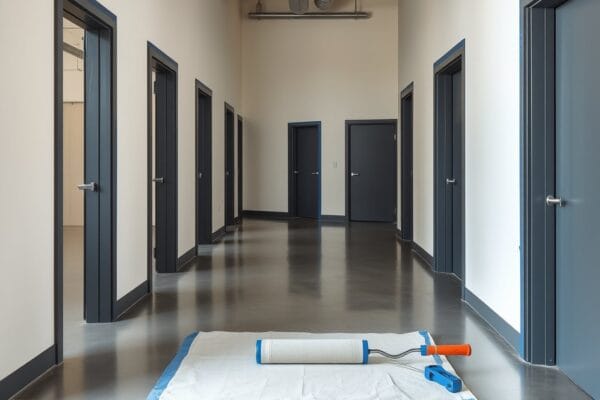
A rental gets repainted because it needs to relet, not because a timer went off. That is why two identical units in the same building can go on wildly different schedules. A unit that turns over every year sees paint far more often than one held by the same tenant for six years, even though the long tenancy usually needs a far bigger job when it finally ends.
Think of it as three overlapping triggers:
- Move-out trigger. The unit is empty, you have a vacancy window, and the paint decides how the unit shows. This is when most rental painting happens.
- Condition trigger. Something has failed independently of tenancy: water staining, a wall that has been scrubbed back to the substrate, a corridor that reads dingy in photos. You fix it when it fails.
- Standards trigger. A local housing code, a lease clause, a lender or insurer requirement, or your own portfolio standard says the unit must be in a certain condition. If any of these apply to you, they override everything above.
Most portfolio owners run a hybrid. Full repaints happen at turnover. Between turnovers they touch up on request and repaint only the surfaces that have failed. The common areas run on their own schedule because they never go vacant.
Short tenancy versus long tenancy
The single biggest predictor of how much paint a unit needs at move-out is how long the tenant was there.
A short tenancy of a year or two, in a unit that was painted properly at the start, usually comes back needing spot work rather than a full repaint. Patch the picture hooks, fill the anchor holes, touch up the scuffs at hip height along the hallway, repaint one wall if a section will not blend, and the unit shows fine. This only works if the original paint job was done with a product and colour you can still buy and match, which is the whole argument for standardising.
A long tenancy of five or more years almost always needs a full repaint. Not because the tenant did anything wrong, but because paint ages. It yellows slightly, it collects a film of cooking residue and airborne dust, it gets cleaned in patches so the sheen goes uneven, and it accumulates hundreds of tiny marks that individually are nothing and collectively read as tired. Touching up a wall that has aged for six years will not blend. The touched spot will look newer than the wall around it, which is worse than not touching it at all. See how to touch up paint for why blending fails on aged coatings.
This is also why a landlord charging a long-term tenant for a full repaint is usually on shaky ground. Paint that has reached the end of its life through ordinary ageing is generally treated as the owner’s cost, not the tenant’s. The details vary enormously by jurisdiction, so read landlord vs tenant painting responsibilities and check your local tenancy authority.
What normal wear and tear tends to mean in practice
Almost every tenancy framework distinguishes between deterioration that happens from living in a place normally and damage caused by carelessness, misuse or neglect. The exact wording and the exact line differ by country, state or province, and city, and your lease may define it further. The practical distinction most people apply looks roughly like this.
| Commonly treated as wear and tear | Commonly treated as damage |
|---|---|
| Scuffs at hip and shoulder height along traffic routes | Large gouges, kicked-in panels, holes bigger than a fixing |
| Small nail and picture-hook holes | Dozens of anchor holes, or mounting hardware ripped out of the board |
| Paint fading, yellowing or losing sheen over years | Painting a wall a colour without permission |
| Light marks around switches and door handles | Crayon, marker or spray paint across a wall |
| Hairline cracking at joints from building movement | Water damage from an overflowed bath left unreported |
| General dulling in a kitchen from cooking residue | Heavy nicotine staining through the whole unit |
Treat that table as a common-practice summary, not as a legal test. In many jurisdictions the deciding factor is whether the condition is consistent with ordinary use over the length of the tenancy, and adjudicators tend to weigh the age of the existing paint heavily. A mark on a coating that was already near the end of its life is a different question from the same mark on a coating applied last month. Again: not legal advice, and the rules vary.
The parts that fail first
Paint does not wear evenly. If you want a repaint interval that is actually cost-efficient, stop thinking about “the unit” and start thinking about surfaces with different lifespans. A rental typically has four or five distinct wear zones and they fail in a predictable order.
- High-traffic corridors and stairwells. Shoulders, bags, prams, furniture being moved. In a shared building these are the fastest-failing surfaces you own and they never go vacant, so they need their own maintenance cycle. Product choice matters more here than anywhere else, which is the subject of best paint for high-traffic areas.
- Kitchens. Grease film, steam, splashes behind the hob, constant wiping. Kitchen walls need a scrubbable finish and they show wear years before a bedroom does.
- Bathrooms. Moisture, condensation on ceilings, mildew in poorly ventilated units. Bathroom ceilings are often the single surface that forces an out-of-cycle repaint.
- Skirting, door frames and doors. Vacuum strikes, shoes, pets, handles. Trim takes physical abuse rather than chemical abuse, so it chips rather than dulls, and chips are visible from across a room.
- Around light switches and sockets. Hand oils and repeated contact. A tiny area with an outsized effect on how clean a unit looks in a viewing.
Bedrooms and living-room walls above door height, by contrast, can go many tenancies without needing anything. If you repaint the whole unit every turnover, you are repainting a lot of surface that had years of life left. That is the main way rental painting budgets get wasted.
A workable default cycle
Here is a structure that most portfolio owners converge on. Adapt it to your building, your tenant profile and any local requirement that applies to you.
| Surface | Typical trigger | Why |
|---|---|---|
| Whole unit, walls and ceilings | End of a long tenancy, or when spot work stops blending | Ageing is uniform, so partial work shows |
| Kitchen and bathroom | More often than the rest of the unit | Moisture and grease shorten coating life |
| Trim, doors, frames | Every turnover as touch-up, full recoat when chips accumulate | Physical damage is local and repairable |
| Corridors and stairwells | On a fixed maintenance cycle, independent of tenancies | Never vacant, constant wear |
| Bedrooms and living areas | Touch-up between short tenancies, full coat when tired | Slowest wear in the unit |
The point of the table is not the frequency, it is the principle: paint the surfaces that failed, on the schedule they failed on, and stop treating the unit as one item.
Why standardising makes the interval cheap
The interval question is really a cost question. A landlord who repaints every turnover is not being wasteful if each repaint is fast and cheap. A landlord who repaints rarely is not saving money if every repaint is a bespoke job with colour matching, multiple products and a long vacancy.
Standardisation is what collapses the cost. One neutral wall colour, one ceiling white, one trim colour and sheen, one product line, across every unit you own. The effects compound:
- Touch-ups always match. You never have to guess a colour or send a chip off for matching. A jar of the standard colour touches up any wall in any unit.
- You buy in volume. Fewer product lines, larger containers, less waste from part-used cans of colours you will never use again.
- Anyone can do the work. A handyman, a new crew, or you, without a briefing. There is one right answer per surface.
- Spot repaints become viable. When the paint on the wall is the same age-tolerant product you have in the store cupboard, repainting one wall instead of four is a real option.
- Vacancy shrinks. No waiting on a colour match, no sample pots, no decision-making. The unit gets painted the day it empties.
The product decision behind all of this is covered in best paint for rental properties, and the process for executing a turnover repaint quickly is in how to paint a rental property.
When to repaint mid-tenancy
Sometimes the unit is occupied and it still needs paint. Common triggers are a water leak that has been repaired and left a stain, mould in a bathroom that has been remediated, or a tenant renewing a long lease and asking for a refresh as part of the renewal.
Painting an occupied unit is slower and more disruptive than painting a vacant one. You cannot spray, you cannot move freely, you have to work around furniture and around the tenant’s schedule, and you often lose half a day to protection alone. If the work can wait until the unit is empty, waiting is usually cheaper. If it cannot, do the affected room only, and price it as an occupied job rather than a turnover job.
A mid-tenancy refresh at renewal can be worth it commercially. Keeping a good tenant for another term is often worth more than the paint costs, and the work is limited to the rooms that actually need it.
Document the condition every single time
Whatever interval you settle on, the thing that protects you is documentation, not frequency. A dated condition report with photographs at move-in and again at move-out, covering every room, with close-ups of any existing marks, is the single most useful record either side of a tenancy can have. It establishes when the paint was applied, what condition it was in, and what changed.
Without it, any conversation about who pays for the repaint becomes one person’s recollection against another’s. With it, most disputes never start. Keep a simple log per unit: the date the unit was last fully painted, the colour and product used, and which surfaces were done. That log answers the “how often” question for your portfolio better than any general rule can.
What to do next
Set your own standard rather than looking for an external one. Pick your colours and products, write down the surfaces and their triggers, photograph every unit at every handover, and check whether your jurisdiction or your local housing code imposes anything stricter. Then repaint when the surface has failed or the unit is empty, whichever comes first.
If you are working out what the work should cost, start with cost to paint an apartment. If you want the practical execution sequence, go to how to paint a rental property. And for the question of who pays for what at move-out, read landlord vs tenant painting responsibilities, keeping in mind that tenancy rules vary by jurisdiction and that this is general information rather than legal advice.
Frequently asked questions
Is there a law that says how often a landlord must paint?
In most places there is no general statute setting a fixed repaint interval, but some jurisdictions and local housing codes do set condition or habitability standards that can effectively require repainting, and some leases impose their own terms. This varies enormously by country, state or province, and city, so check your local tenancy authority. This is general information and not legal advice.
Do I have to repaint between every tenant?
Usually not. If the previous tenancy was short and the existing paint is a standard colour and product you can still match, patching and touching up is often enough. Full repaints make more sense after long tenancies, when the coating has aged uniformly and touch-ups will no longer blend.
Can I charge the tenant for repainting?
Commonly, deductions are expected to reflect actual damage beyond normal wear and tear rather than ordinary ageing, and the age of the existing paint is often weighed heavily. The rules differ by jurisdiction and your lease terms matter, so check with your local tenancy authority before making any deduction. Not legal advice.
Which parts of a rental need painting most often?
High-traffic corridors and stairwells, kitchens, bathrooms, trim and door frames, and the areas around light switches. Bedroom and living-room walls above door height wear slowest and can often survive several tenancies untouched.
Should every unit in my portfolio be the same colour?
Yes, if you can manage it. One neutral wall colour, one ceiling white and one trim colour across the portfolio means touch-ups always match, you buy in volume, and any painter can work on any unit without a colour brief. It is the cheapest single decision in rental maintenance.
Is it worth repainting while a tenant is still living there?
Only when something has failed, such as a repaired leak leaving a stain, or when a refresh is part of keeping a good tenant on renewal. Occupied painting is slower because you cannot spray and you lose time to protection and access, so most work is better scheduled into the vacancy window.