In this article
- Height changes the job, not just the equipment
- The access ladder, in order of what it demands
- What access costs beyond the rental charge
- Moving the equipment is the hidden hours
- Rent, own, or have it erected
- Pricing access as its own line
- Interior height: stairwells and double height rooms
- Safety is a cost line, not an option
- When access decides whether to take the job
- Frequently asked questions
Height does not only change which ladder comes off the van. It changes how fast the crew works, how often everything has to move, what has to be delivered, who is allowed to use it and what happens to the ground underneath. A wall twice as high is rarely twice the work. It is usually more.
Most underpriced exterior jobs and a surprising number of interiors go wrong here, because access is treated as something the painter already owns and therefore free. It is not free even when it is owned, and when it has to be rented the rental charge is often the smallest part of what it costs.
Height changes the job, not just the equipment
On a single story wall a painter works from the ground or a short ladder and moves freely. Every foot of height after that adds time that has nothing to do with painting: climbing, repositioning, carrying materials up, reaching less of the wall from each position and working more slowly because a mistake costs more.
Production rates taken from ground level work do not survive that. A rate that is right for a fence is wrong for a gable, and the correction is not a small percentage. The general approach to adjusting rates for conditions is in painting production rates, and access is usually the largest single condition on an exterior.
The practical test on site is simple. For each elevation, ask how the crew will physically reach every part of it, how many times the access will have to move, and what is underneath it. Those three answers change the estimate more than the square footage does.
The access ladder, in order of what it demands
Access methods fall into a rough order, and each step up adds set up time, cost and competence requirements.
Stepladders and extension ladders. Cheap, fast to move, and suitable for short duration work where the painter can keep proper contact and does not have to overreach. Choosing the right one is covered in how to choose a ladder for painting, and the honest limit is that ladders become slow and tiring well before they become impossible.
Ladders with planks and ladder accessories. They extend what a ladder can do on long runs of wall at modest height, at the cost of more setting up and more to move.
Mobile towers. Faster to work from than ladders on large areas, but they need level firm ground, assembly by somebody who knows how, and time to relocate.
Scaffold. Usually erected by a specialist, left in place for the duration, and the most comfortable and productive platform once it is up. Its cost is dominated by erection, rental period and dismantling rather than by the time the painters spend on it.
Powered access. Boom and scissor lifts reach heights and positions nothing else can, quickly, but need suitable ground, space to operate, and trained operators.
What access costs beyond the rental charge
When a painter prices access by looking up a rental rate, several costs get missed. Listing them explicitly is the quickest way to stop losing money on high work.
Delivery and collection, which can be charged separately and on a distant job can rival the rental itself.
Erection and dismantling, either by the crew in paid time or by a specialist on their own quote.
Moves. Every relocation of a tower or lift is time the crew is not painting. On a house with many corners, projections and obstacles the moves can take a substantial share of the day.
Ground and protection. Boards under feet or outriggers, protection for paving, lawns and planting, and sometimes permission to use a neighbouring property or the sidewalk.
Rental period risk. Weather that stops work does not stop the rental clock. A scaffold rented for two weeks on a job that runs three is a week of cost the estimate did not contain.
Competence. Only people trained and authorized should erect towers or operate lifts, and that training has a cost whether it is paid for directly or carried by the business.
Inspection and daily checks. Equipment should be checked before use and after anything that could affect it, which is time, and it is time that cannot be skipped.
Moving the equipment is the hidden hours
Of everything on that list, moves are the item most often missing from estimates, because they are invisible when the job is walked and very visible once it runs.
Count them. Walk each elevation and note how many positions the tower, ladders or lift will need, and what has to be cleared, protected or dismantled to reach each one. A plain elevation might need a few positions. The same area broken up by bays, porches, conservatories and planting might need several times as many.
Then estimate the time per move from your own experience with that equipment on that kind of ground, and put the total in the estimate as access labor rather than folding it into painting hours where it will be forgotten next time.
Rent, own, or have it erected
The right answer depends on how often the equipment is used and who is competent to put it up.
Owning makes sense for equipment used on most jobs, typically ladders, planks and perhaps a tower. Owned equipment still has a cost per job, because it wears, needs inspection, storage and transport, and eventually replacement. Spread that cost across the jobs that use it rather than treating it as free.
Renting suits equipment used occasionally, such as lifts or larger towers. The rental charge is visible, but the delivery, the rental period risk and the operator competence all come with it.
Specialist erected scaffold suits jobs where height, duration or complexity make anything else slow or unsafe. The painter then prices the scaffold as a subcontract with its own quote, adds a margin for managing it, and carries the risk of the rental period running over.
A common mistake is to choose the cheapest access to rent rather than the cheapest access in total. A lift that costs more per day than a tower can still be cheaper on a job where it removes most of the moves and finishes days earlier.
Pricing access as its own line
Access belongs on the estimate as a named line, separate from painting labor. That has three advantages.
It stops access being lost. When the cost of scaffold is folded into a square foot rate it disappears the next time the rate is used on a job without scaffold, and reappears as a loss on the next job that needs it.
It explains the price. A customer comparing quotes can see why a tall house costs more than a bungalow of similar area, and a competitor who left access out looks cheap for a visible reason.
It gives something to adjust. If the customer wants the price lower, access is often where a different method or a different schedule can save money without touching the specification.
On exterior work, the step by step structure of an estimate with a separate access allowance is shown in how to estimate exterior painting. Inside, where tall stairwells and double height rooms need towers or boards, the same principle applies to the interior line.
Interior height: stairwells and double height rooms
Access is usually thought of as an exterior problem, and interiors get priced as if every wall can be reached from a stepladder. Two kinds of room break that assumption on almost every house that has them.
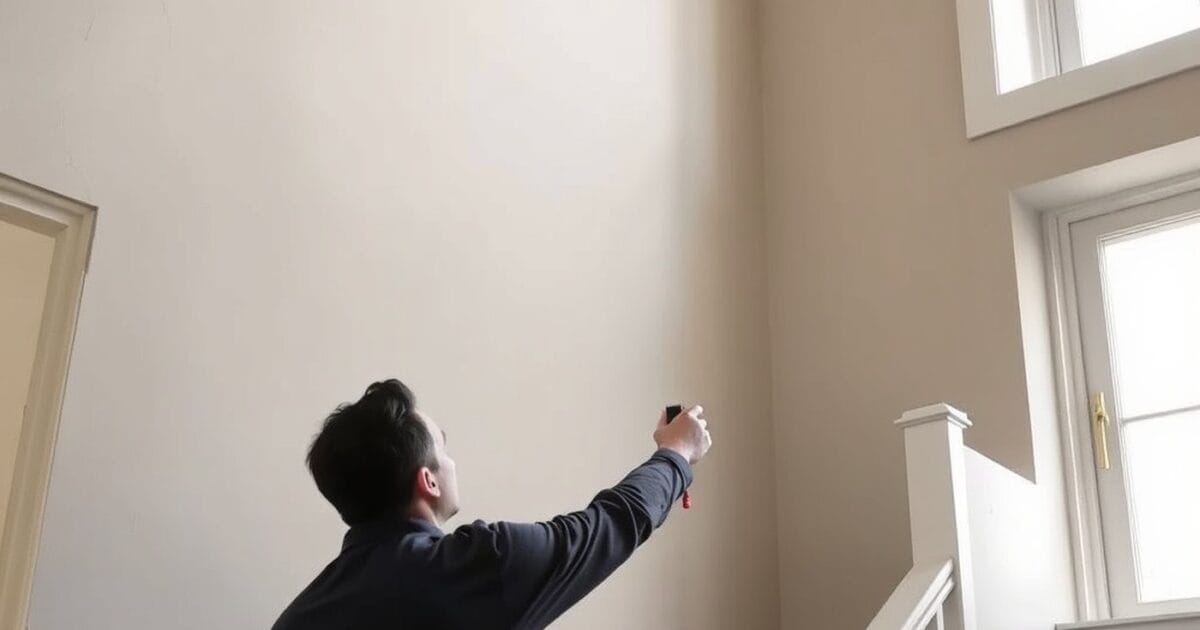
Stairwells. The wall over the stairs is often the tallest interior surface in the home, and the floor beneath it is not level. Reaching it safely takes a combination ladder, a platform system designed for stairs, or boards across secure supports, and setting any of those up takes far longer than setting a stepladder in a bedroom. The stair treads and handrail also need protecting, and the stairs are frequently the only route through the house, so the set up may have to come down at the end of each day.
Double height rooms and atriums. A tall entrance hall or open living space can need a tower inside the house, which brings its own problems: carrying the components through finished rooms without marking them, protecting the floor under the wheels or base plates, and room to assemble it. On larger commercial interiors the same space may justify a scissor lift, with the added question of whether the floor can take its weight and whether it fits through the doors.
Price these rooms separately from the rest of the interior. A whole house estimate that applies one production rate to every wall will be right for the bedrooms and wrong for the stairwell, and the stairwell is where the time goes. Note on the estimate what access has been allowed for, so that a customer who later asks why the hall costs more than a larger bedroom can see the answer.
Ceilings follow the same logic. A high ceiling worked from the floor with an extension pole is quick. The same ceiling with detail that has to be cut in by hand needs a platform under every part of it.
Safety is a cost line, not an option
Working at height is where the most serious injuries in painting happen, and the requirements attached to it are not optional extras that can be dropped to win a job.
The Occupational Safety and Health Administration publishes guidance on fall protection, on scaffolding in construction, and the requirements for aerial lifts. Read what applies to the work you actually do and price in what it takes to comply: the right equipment, the training, the inspections and the time to set up properly.
A quote that only works if corners are cut at height is not a competitive quote, it is a risk the business is choosing to carry. The kit that belongs on every job is listed in the painting safety equipment checklist.
When access decides whether to take the job
Sometimes the honest outcome of pricing access properly is that the job is not a good fit.
Access the business cannot provide safely. If a job needs powered access and nobody on the crew is trained to operate it, the options are to train, to subcontract that part, or to decline. Guessing is not one of them.
Access that dominates the price. On some jobs the access costs more than the painting. That can be fine, but it is worth checking whether the customer understands what they are paying for, and whether a specialist with their own equipment is better placed.
Access with unknown ground. Soft ground, steep slopes and tight boundaries can turn a straightforward tower job into something much slower. Where the ground cannot be assessed properly on the survey, the estimate should say what has been assumed.
Sequencing with others. Scaffold erected for another trade can sometimes be used by the painter, which changes the price entirely. Whether it can be used, for how long, and who is responsible for it has to be settled in writing before relying on it.
The conditions are what make the price.
PaintPricing builds an itemised estimate from your own rates, so travel, access, repairs and extras sit on the quote as lines the customer can see rather than hiding inside one number. Free for your first 3 quotes, no card required.
Frequently asked questions
How do painters price scaffolding on a job?
Scaffold is usually priced as its own line, either from a scaffolding contractor quote for erection, rental period and dismantling plus a margin for managing it, or from the cost of owned equipment and the crew time to put it up. It should not be folded into a square foot painting rate.
Is it cheaper to use a lift or a tower for high painting work?
It depends on the job. A lift often costs more per day to rent, but on a building with many positions it can remove most of the moves and finish sooner, which can make it cheaper in total. Price both where either could work.
Should I charge for ladders I already own?
Owned equipment still wears, needs inspection, storage and transport, and eventually replacement. That cost should be recovered across the jobs that use it, either through overhead or through a small access allowance, rather than treated as free.
What access costs do painters most often forget?
Moving the equipment between positions, delivery and collection, protection for the ground underneath, and rental periods that run longer than planned because of weather or delays. Moves are the most commonly missed.
Do painters need training to use scaffolding or lifts?
Erecting towers and scaffold and operating powered access should only be done by people trained and authorized for that equipment. Check the OSHA guidance that applies to your work and price the training and competence in rather than assuming it.
How should access appear on a painting estimate?
As a separate named line, with a short description of the method, such as a tower on the rear elevation or a lift for the gables. That explains the price, protects it from being lost when rates are reused, and gives something to adjust if the customer needs a lower figure.