In this article
- Ceilings that behave like trim
- Measuring beams, coffers and boards
- Real timber, box beams and faux beams
- Stained, painted or raw
- The joints between boards
- Height, vaults and access
- Coffered ceilings and the corners inside them
- Open joists and basement ceilings
- Protection below the work
- Building the ceiling line
- Timing overhead detail work
- Frequently asked questions
A flat drywall ceiling is one of the most predictable surfaces a painter prices. A ceiling with exposed beams, coffers, tongue and groove boards or open joists is one of the least. Every beam has three visible faces and two long edges, every coffer is a small box with corners, and every board in a wood ceiling has a groove that catches paint. All of it is overhead, and much of it is well above ladder height.
This guide is for painting contractors pricing beamed, coffered and wood ceilings in homes and small commercial spaces. It covers how to measure them, what the existing finish means for the method, how access changes the job and how to write a line that reflects what is really involved.
Ceilings that behave like trim
The reason these ceilings are hard to price is that they are not really ceilings in the painting sense. They are trim and carpentry installed overhead. A beam is a very large piece of trim. A coffer is a set of moldings forming a box. Tongue and groove boards are a field of narrow surfaces separated by joints. Pricing them by the flat area of the room gives a number that has little connection with the work.
Painting overhead is also slower and more tiring than painting at chest height, and precise cutting in overhead is slower still. Paint drips and spatters fall on the painter, the floor and anything below. The crew needs more breaks, more ladder moves and more protection. All of that belongs in the rate for overhead detail work.
For flat ceilings, how much to charge to paint a ceiling sets out the standard approach. This guide deals with everything that interrupts a flat ceiling.
Measuring beams, coffers and boards
Each ceiling type has a natural unit. Beams are measured by run, with their size and the number of visible faces noted, because a beam against a wall shows fewer faces than one in the middle of a room. Coffered ceilings are counted by the number of coffers, with the size of each and the profile of the molding noted. Tongue and groove, beadboard and plank ceilings are measured by area, with a band for the board width and joint style. Open joists in basements are counted by the number of joists and their length, with the bays between them noted separately.
The flat drywall between beams or inside coffers is still ceiling, and it can be priced by area. The standard method of measuring a ceiling for paint is in how to measure a ceiling for paint. The additional step here is to subtract nothing for the beams and add them as their own measured item, so the flat area and the detail are both on the estimate.
Useful notes for each ceiling include the height at its highest and lowest points, whether it is vaulted or flat, the number of light fixtures, fans and vents to work around, and anything hanging from the beams such as pendants or track lighting.
Real timber, box beams and faux beams
Not all beams are the same material. Solid timber beams may be rough sawn, planed, or old reclaimed wood with checks and cracks. Box beams are built from boards around a frame and have seams at the corners. Faux beams may be made from lightweight wood, fiberboard or polyurethane foam that imitates wood.
Each needs a different approach. Rough sawn timber soaks up paint and needs a heavy nap or a brush worked into the grain. Checked timber has cracks that can hold paint or need filling. Box beams need their seams caulked. Foam beams need a primer suited to the material and should not be sanded aggressively. Identify the material on the walkthrough, because it changes both the preparation and the product.
Stained, painted or raw
The most common request is to paint beams or a wood ceiling that was previously stained. That means cleaning, deglossing or scuff sanding any clear coat, and priming with a product that bonds to it and blocks tannin bleed. Knots in pine boards are notorious for bleeding through paint, sometimes long after the job is finished, and a stain blocking primer over knots is cheap insurance against a callback.
Raw wood ceilings, such as new tongue and groove in an addition, need priming and possibly back priming if the boards are not yet installed. Previously painted ceilings may only need cleaning and a fresh coat, although peeling paint on old boards is common in bathrooms and porches, and scraping overhead is slow.
Some customers want beams stained rather than painted, often to contrast with a white ceiling. Staining overhead is a different job. It shows lap marks easily, it cannot hide mistakes the way paint can, and it usually needs the wood clean or sanded to bare. Price it as a separate item with its own method. Sanding wood overhead also produces a lot of fine dust, and OSHA provides an overview of the hazards of wood dust.
The joints between boards
Tongue and groove and plank ceilings have a joint between every board. Paint that bridges the joint can crack as the boards move with humidity, leaving thin lines of the old finish showing. Paint that misses the joint leaves a dark line. The painter has to work paint into each joint without flooding it, which is slow with a brush and difficult with a roller.
Many painters spray wood ceilings for this reason, then back brush or back roll to push paint into the joints. Spraying overhead in a finished room requires full masking of walls, floors and fixtures, which is a significant part of the job. The same principles appear in the homeowner method in how to paint a ceiling, where overhead technique and protection are set out, and they scale up on a board ceiling.
If the boards are stained and the customer wants them white, expect the joints to show the old color unless they are primed carefully. It is worth doing a small test area and showing the customer before committing to the whole ceiling.
Height, vaults and access
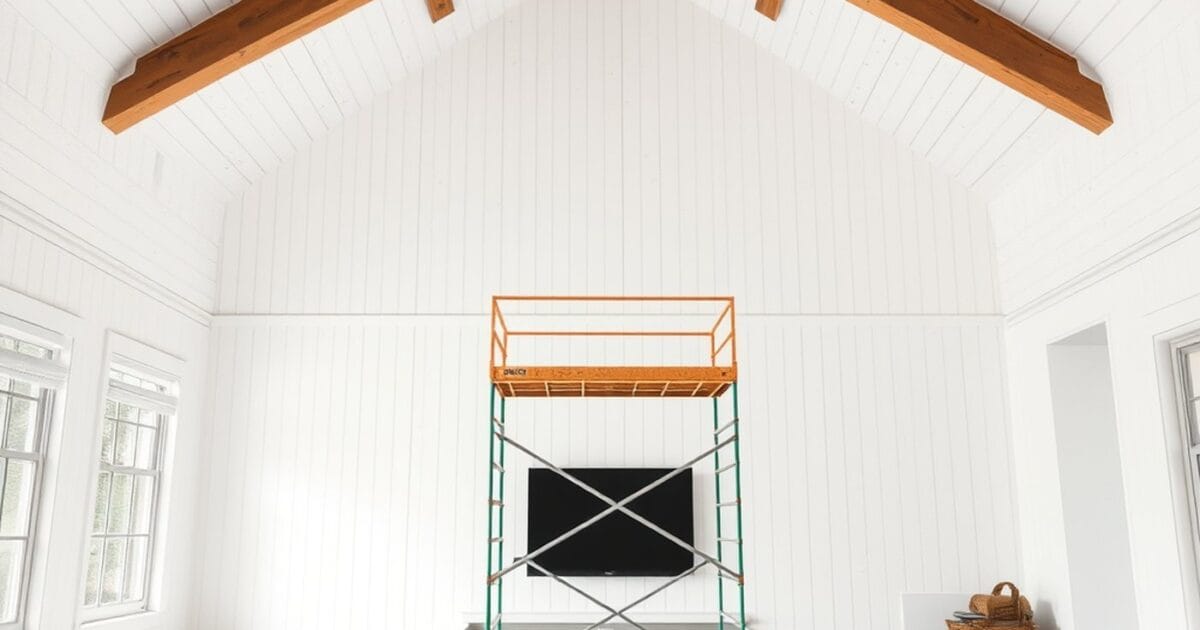
Beamed and wood ceilings are often in great rooms, vaulted living rooms, lofts and porches, where the ceiling is much higher than in an ordinary room. Access becomes the largest single factor in the price. A step ladder that works in a standard room is useless under a vault. Extension ladders, ladder levelers, rolling scaffold or a small lift may be needed.
Access equipment needs to be delivered, set up, moved and taken down, and it slows the work around it. The pricing of access equipment is covered in how to price access equipment for painting jobs. OSHA publishes guidance on scaffolding in construction, and working overhead at height on a scaffold or ladder is exactly where that guidance applies.
Vaulted ceilings add another challenge: the ridge beam may be well above anything else, and the beams descending from it change height along their length. Measure the height at several points and price the highest sections as their own band if they need different equipment.
Coffered ceilings and the corners inside them
A coffered ceiling is a grid of recessed panels framed by beams and moldings. Each coffer has four inside corners, four molding runs, the beam faces around it and the flat panel inside. Some coffers have a second layer of molding or a raised panel in the center. The count of coffers, multiplied by the time per coffer for its profile, is the most reliable way to price them.
Coffered ceilings are frequently two colors: white moldings with a contrasting panel, or painted beams with a stained panel. As with any two color work, the lines between colors multiply the cutting in. Price two color coffers as their own band, and record the time separately on real jobs.
Open joists and basement ceilings
A popular way to finish a basement ceiling cheaply is to leave the joists exposed and paint everything, joists, subfloor above, pipes, wiring and ducts, one dark color. This is fast when sprayed in an empty basement, and slow when brushed or when the basement is full of belongings.
Open joist ceilings need thorough masking of walls, floors and anything stored below, and the painter needs to agree with the customer what is painted and what is not. Electrical boxes, gas lines and anything labeled may need to be left unpainted, and plumbing or wiring that is loose should be secured by the appropriate trade first. For large open structures in commercial buildings, the approach in how to price dryfall ceiling painting is the right model.
Protection below the work
Everything below an overhead job is in the drip zone. Floors need full coverage with drop cloths or protection board. Furniture needs moving or covering. Walls may need masking if they are not being painted. Light fixtures, fans and smoke detectors need covering or removing, and some fixtures hang from beams and have to be taken down and reinstalled.
Protection on an overhead detail job often takes as long as a day of painting on a standard job. Treat it as a line of its own, and if the room is furnished, price the moving. The principles are in how to charge for moving furniture when painting.
Building the ceiling line
A clear estimate for a detailed ceiling separates the flat ceiling area from the detail. For example, one line for the flat drywall between beams by area, one line for beams by run and band, one line for coffers by count, and one line for access and protection. That structure lets the customer see why the ceiling costs what it does, and it lets the painter compare the job with the next one.
State the existing finish, the primer, the number of coats, the colors and the method. If the ceiling is being stained rather than painted, or if some parts are stained and others painted, say so. If knots are expected to bleed, note the stain blocker as part of the scope. The broader principles of making an estimate readable are in what should a painting estimate include.
Timing overhead detail work
Overhead detail varies more from job to job than almost any other item, because height, material and profile all change the time. Time a few ceilings carefully, recording the measurement, the band, the height and the access used. Over a few jobs, those records become rates that reflect how the crew actually works overhead. Put them on the painting estimate rate card and use the same bands on every estimate.
Detail work is where square foot pricing loses money.
PaintPricing builds itemized estimates from your own rates, so balusters, windows, built ins and caulk sit on the quote as counted lines instead of disappearing into the wall price. Free for your first 3 quotes, no card required.
Frequently asked questions
How do painters price exposed beams?
Usually by run, with the beam size, visible faces and material noted, and a rate for each band taken from their own timed jobs. The flat ceiling between the beams is priced separately by area.
Is a wood ceiling more expensive to paint than drywall?
Yes, per unit of area. Every board joint needs paint worked into it, stained boards need priming and stain blocking, and the work is overhead. Spraying helps but needs full masking of the room.
Can stained beams be painted white?
Yes, with cleaning, deglossing and a primer that bonds and blocks tannin and knot bleed. A small test area is worth doing first, because some woods bleed through more than expected.
How are coffered ceilings priced?
Most painters count the coffers and price each by size and profile, with a factor for two color schemes. The flat panels inside the coffers can be included in the coffer rate or measured by area.
Why does access add so much to a beamed ceiling?
Beamed and wood ceilings are often vaulted or high, which means extension ladders, scaffold or a lift. That equipment takes time to set up and move, and the work at height is slower.
Should an open joist basement ceiling be sprayed?
Usually, if the basement can be emptied and masked. Spraying reaches between joists and around pipes far faster than a brush. Agree first what is painted and what must stay unpainted.