In this article
- The buyer is a committee, and the committee answers to a congregation
- Money raised before it is spent
- Services, weddings and funerals set the calendar
- Sanctuary ceilings are taller than they look
- Old plaster, old paint and what is underneath
- Decorative work, stencils and gilding
- Protecting what cannot be replaced
- Halls, classrooms and the rest of the campus
- Volunteers, donated labor and the painter who is asked to share
- Exteriors, steeples and the parts nobody can reach
- Building the church price
- Frequently asked questions
Churches, temples, mosques, synagogues and other houses of worship are some of the most memorable buildings a painter will work in, and some of the most misjudged at the estimate stage. The sanctuary ceiling is higher than it looks, the plaster is older than anyone remembers, the schedule is set by services and events, and the decision is made by a committee that may meet once a month.
This guide is written for the painting contractor pricing work for a congregation. It covers how the buyer decides, what the building usually hides, and how to build a price that survives both the committee and the ceiling. The same principles apply across faiths and denominations, although every congregation has its own traditions and its own rules.
The buyer is a committee, and the committee answers to a congregation
In most congregations, the person who calls the painter is not the person who decides. There is usually a building or property committee, a governing board and sometimes a vote of the wider membership for larger projects. Clergy may have strong views about the worship space without holding the budget.
That structure makes the sales process slow and the proposal important. The painter often presents to a committee, and the committee presents to someone else. A proposal that explains the scope clearly, shows options and answers the obvious questions in writing will travel further than one that needs the painter in the room. The structure described in hoa painting projects for proposals that must survive a vote applies almost unchanged.
Ask early how the decision is made, who signs the contract and when the next meeting is. A proposal that arrives the day after the committee met can wait weeks for the next one.
Money raised before it is spent
Many congregations fund major repairs through a capital campaign, a designated fund or a gift from members. The budget is often fixed before the painter arrives, and it may have been set from a guess rather than an estimate.
That creates two common situations. Sometimes the budget is too small for the full scope, and the painter is asked to fit the work to the money. Sometimes the congregation is still raising funds and wants a number to put in front of members. In both cases, options help. Presenting a base scope and additional options, each with its own price, lets the committee match the work to the funds without asking the painter to cut the price. The approach is in how to price painting jobs in tiers.
Be careful with free estimates for fundraising. A detailed proposal takes real time, and a congregation that uses it to set a campaign target may then put the job out to bid. Agree in advance whether the proposal is a budget figure or a firm price, and how long it stands.
Services, weddings and funerals set the calendar
The worship space is in use on a regular weekly pattern, and also for weddings, funerals, holidays, concerts and community events that may be booked months ahead or with a few days notice. A funeral cannot be moved to suit a painter.
Get the full calendar before scheduling, and agree which events take priority. Plan the work so that the space can be cleared, cleaned and made presentable for every service, which may mean removing scaffolding or covering it on a weekly cycle. That cycle is a cost, and it belongs in the price.
Where the congregation cannot give up the sanctuary for long, phasing may be the answer: one section at a time, with the rest of the room usable. The pricing of phased work is covered in how to price a painting job done in phases.
Sanctuary ceilings are taller than they look
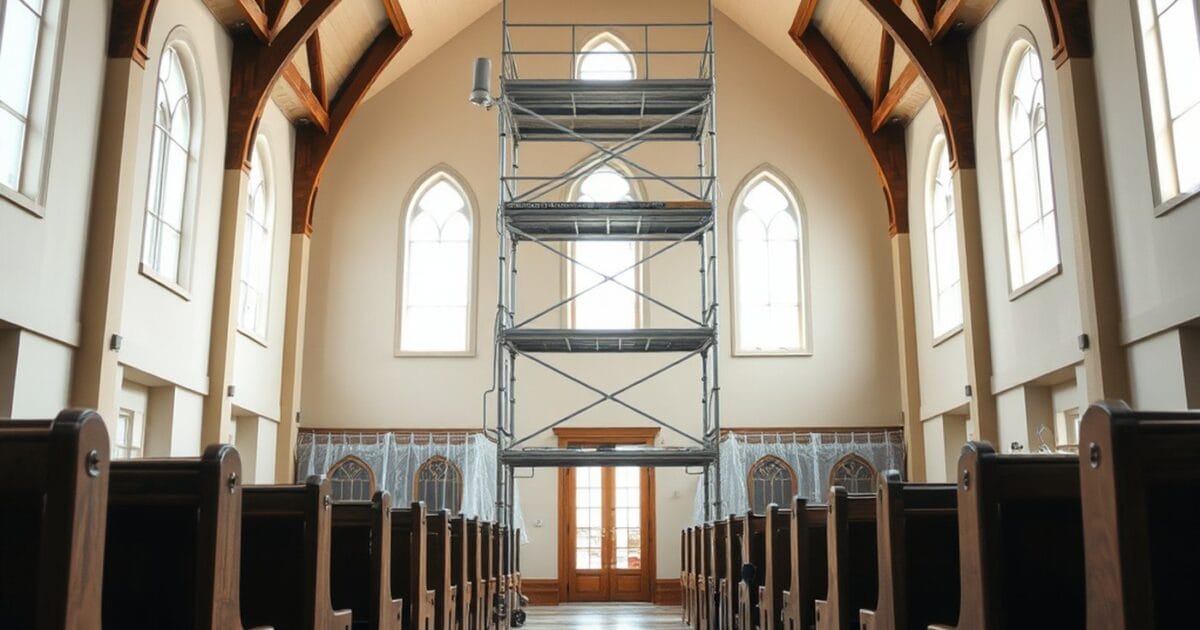
Worship spaces are designed to feel large, and the height is usually greater than a quick look suggests. Vaulted ceilings, exposed trusses, domes and clerestory windows all put paintable surfaces well above the reach of ladders.
Measure the height rather than estimating it, and plan access before pricing. Scaffolding, rolling towers and lifts each have their place, and the floor, the pews and the fixed furnishings determine which will work. Pews may have to be protected, moved or worked around. A sloping floor or a raised platform complicates everything. The pricing of access is set out in how to price access equipment for painting jobs, and scaffolding safety is covered in the OSHA page on scaffolding in construction.
Production at height is slower than production at floor level. The time needed to paint a ceiling of a given area rises sharply as the ceiling rises, because every move of the access equipment interrupts the work. How long does it take to paint a ceiling gives the baseline for ordinary rooms, and a sanctuary ceiling should be priced as a multiple of that baseline, not a small addition.
Old plaster, old paint and what is underneath
Many worship buildings are old, and many have plaster walls and ceilings that have been painted many times. Plaster cracks, delaminates and suffers from water damage from old roof leaks. Paint layers build up and eventually fail together. Decorative plaster may have been painted over in ways that hide its detail.
Inspect closely, from the access equipment if possible, before committing to a price. Tap for loose areas, look for staining from past leaks and ask when the roof was last repaired. The National Park Service guidance on repairing historic flat plaster explains the common failure types and why they need to be addressed before painting.
Older paint may also contain lead. If the building is old enough, test before any work that disturbs the surface. The rules for work in older buildings are summarized on the EPA page on the Renovation, Repair and Painting program, and testing options are in how to test for lead paint.
The choice of ceiling paint matters more than usual, because the ceiling may not be repainted for a long time and is hard to reach once the scaffold is gone. Best paint for a ceiling covers the general choice, and in a tall sanctuary it is worth spending more on product to avoid a second mobilization.
Decorative work, stencils and gilding
Some worship spaces have decorative painting: stenciled borders, painted panels, faux finishes, gilded details or murals. Some are historically significant. These are specialized trades, and many painting businesses are not set up for them.
Decide early whether decorative work is in scope, out of scope or referred to a specialist. Where it stays, protect it carefully during general painting. Where it is being restored, the approach described in the National Park Service brief on painting historic interiors is a useful reference for the questions a committee may ask.
Never paint over decorative work without explicit written instruction. Once covered, it may be impossible to recover, and the congregation may not realize what it had until it is gone.
Protecting what cannot be replaced
Worship buildings contain things that matter far beyond their value: organs, stained glass, carved woodwork, memorial plaques, altar furnishings, artwork and objects donated by families over generations. Some of it cannot be moved, and some of it cannot be replaced at any price.
Agree with the committee what will be moved, by whom, and where it will be stored. Many congregations prefer their own members to handle sacred objects. Anything that stays in place needs protection that suits it: a sealed cover for an organ console, careful masking around memorial plaques, and extra care on scaffold near stained glass.
Document the condition of valuable items before work starts, with photographs agreed by the committee. A small scratch found afterward on a carved screen can become a serious dispute if nobody recorded that it was already there. The protection itself is time, and it belongs in the price as its own line.
Halls, classrooms and the rest of the campus
The sanctuary is the emotional center of the project, but most congregations own far more: fellowship halls, kitchens, classrooms, offices, nurseries, corridors and sometimes a school or a residence. These spaces are ordinary commercial and residential work, often used every day by community groups.
Price them separately from the sanctuary, using ordinary production rates. They often make the better margin, because they are easier to access and less decorated. They also make a useful first job: a congregation that sees its hall painted well is more willing to trust the painter with the sanctuary.
Where rooms are used by children, product choice, cleanup and scheduling follow the same principles as school work, described in school painting contracts.
Volunteers, donated labor and the painter who is asked to share
Congregations often have members who want to help. Some offer to do the prep, some to paint the halls and leave the sanctuary to the professional, and some to supply materials bought at a discount. These offers are generous, and they create real problems.
Work done by volunteers may not meet the standard the painter will be judged on. Materials bought elsewhere may not be what the painter would use. Liability and insurance questions arise when volunteers work on scaffolding or near professional crews. Decide how to handle these offers before they arise.
A clear approach is to separate the work. Volunteers can do whole rooms that the professional does not touch, and the professional warrants only its own work. The issues with materials supplied by others are covered in customer supplied paint on painting jobs, and the principle is the same.
Exteriors, steeples and the parts nobody can reach
Exterior work on a worship building brings its own challenges: towers, steeples, tall gable ends, stained glass that must be protected and decorative trim that is hard to reach. Many congregations defer this work because it is expensive, and the painter arrives to find years of neglect.
Price the exterior access with the same care as the sanctuary ceiling, and consider whether the tallest elements should be subcontracted to specialists in high access work. Fall protection is not optional on this kind of work; the OSHA page on fall protection sets out the principles. Repair of rotted wood and failing trim often exceeds the painting itself, and the pricing of repairs is covered in how to price repairs on a painting job.
Building the church price
Break the project into areas: sanctuary walls, sanctuary ceiling, decorative elements, halls and classrooms, exterior and high elements. Price each from its own production rates and access plan. Add the cost of clearing and restoring the space for services, the protection of pews and fixed furnishings, and the time spent presenting to the committee.
Present the result with options that let the congregation choose. Explain what the base scope includes and what it leaves out. State how long the price stands, because the decision may take months. Say how weddings, funerals and other events that interrupt the work will be handled, and how the price changes if they do.
Then keep good records. Congregations remember who painted their building, and the next committee will ask the last one who to call.
Every kind of building takes hours away from painting. Price them.
PaintPricing builds itemized estimates from your own rates, so night shifts, containment, escorts, access and protection sit on the quote as lines the client can see, not a guess inside one number. Free for your first 3 quotes, no card required.
Frequently asked questions
Why are church painting jobs harder to price than offices?
Sanctuaries are taller than they look, plaster and paint are often old, the schedule is set by services and events, and the decision is made by a committee. Each of these adds time or risk that an office repaint does not have.
How do painters schedule around church services?
By getting the full calendar of services and events first and planning work so the space can be cleared and cleaned before each one. Phasing the sanctuary, or covering scaffolding on a weekly cycle, is common.
Should volunteers help with the painting?
Only in a clearly separated scope. Volunteers can take whole rooms the professional does not touch, and the professional warrants only its own work. Mixing volunteer and professional work on the same surface causes disputes.
How do I price a tall sanctuary ceiling?
Measure the height, plan the access equipment and price production at height as a multiple of ordinary ceiling rates. Include setup, moves, protection of pews and removal or covering of scaffolding for services.
Do old churches have lead paint?
They may. Older buildings often have lead in earlier paint layers. Test before any work that disturbs painted surfaces, and follow the lead safe practices that apply.
Can I give a congregation a budget number for fundraising?
You can, but agree in writing that it is a budget figure rather than a firm price, how long it stands and whether the final job will go to bid. A detailed proposal takes real time to prepare.