In this article
- Why a staircase breaks square foot pricing
- Counting the parts of a staircase
- Profiles decide the hours
- Two tone stairs and the lines between colors
- Condition and the existing finish
- Preparation that happens one baluster at a time
- Keeping the stairs usable while they cure
- Brush, mitt or spray
- Open stairwells and access
- Metal balusters in a wood staircase
- Building the stair line on the estimate
- Timing your own stairs
- Frequently asked questions
A staircase looks like a small job on a walkthrough. The floor area is modest, the wall area is a stairwell the painter has priced before, and the balusters are thin enough that they hardly seem to count. Then the crew starts, and the day disappears into dozens of turned spindles, a handrail that has to be sanded by hand, and a set of treads nobody can walk on while the paint cures.
This guide is for the painting contractor pricing the parts of a staircase that are not wall: the balusters, newel posts, handrails, stringers, skirt boards, treads and risers. It explains why square foot pricing fails on stairs, how to count what is actually there, which details move the time, and how to turn all of it into a line on the estimate that the customer can understand and the crew can deliver.
Why a staircase breaks square foot pricing
Square foot pricing works when the time to paint a surface rises roughly with its area. Walls and ceilings behave that way. A staircase does not. A single baluster has almost no area, but it has four faces, several edges, a top joint into the rail and a bottom joint into the tread or shoe, and each of those needs attention. Multiply that by every baluster on the stair and the painter is working on a surface with far more edge than face.
Edges are where time goes. Every edge needs a clean line, every joint needs caulk or careful brushing, and every turned profile needs paint worked into its grooves without runs collecting at the bottom. None of this shows up in a measurement of area, which is why painters who price stairs by the square foot, or who fold them into the stairwell walls, tend to lose money on them.
The walls of the stairwell are a different question, and one covered in how much to charge to paint a stairwell. This guide treats the staircase itself as a separate item with its own count, its own condition and its own line.
Counting the parts of a staircase
The first step is a proper inventory, done on the walkthrough and written down. A stair that is described as a staircase on the estimate cannot be checked, cannot be compared with the next one and cannot be priced consistently. A stair that is described by its parts can.
The usual parts are:
- Balusters, also called spindles, counted individually and noted by profile.
- Newel posts at the bottom, at landings and at turns, counted and noted by size and detail.
- Handrail, measured by run, with any curves, easings or goosenecks noted.
- Shoe rail or base rail, if the balusters sit on one rather than on the treads.
- Stringers and skirt boards on each side, measured by run.
- Treads and risers, counted, with a note on whether they are painted, stained or carpeted.
- Landings, nosings and any trim returns.
A quick way to keep the count accurate is to photograph each run from the same position and count from the photo afterward. The method of pricing from images is covered in how to price a painting job from photos, and it is especially useful on stairs because balusters are easy to miscount standing in the stairwell.
For the paint quantity on balusters, the stair spindle painting calculator converts a count and a profile into an estimate of material. The labor is the larger question and is dealt with below.
Profiles decide the hours
Two staircases with the same number of balusters can take very different amounts of time. The difference is the profile. A plain square baluster has four flat faces and can be painted quickly with a good brush. A turned baluster has beads, coves and tapers that catch paint and hide missed spots. A carved or twisted baluster is slower again, and some older homes have balusters with detail that can only be painted properly one small section at a time.
It helps to band balusters into a few profile groups and keep them consistent across every estimate. For example, a painter might use plain, turned and ornate as three bands, and record a separate time for each from real jobs. The bands matter more than the exact names, because the goal is that the next estimator on the next stair puts the same baluster into the same band.
Newel posts deserve the same treatment. A plain box newel is little more than a short column. A newel with raised panels, a turned cap, applied moldings or a volute at the bottom of the rail is a small piece of joinery and should be priced as one.
Two tone stairs and the lines between colors
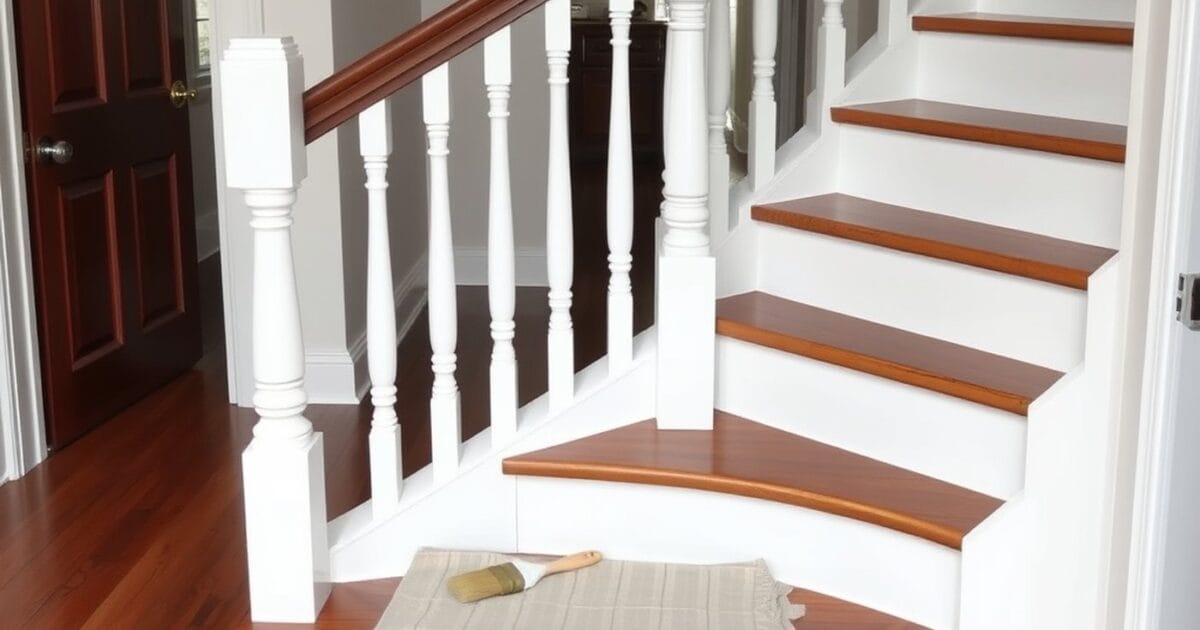
Many staircases are finished in two colors. A common scheme has white balusters and risers with a stained or darker painted handrail and treads. Another has painted balusters with the newel and rail left natural. Each color change creates a line that has to be cut by hand, and on a staircase those lines are everywhere: the top and bottom of every baluster, the edges of every tread, the joint between rail and newel.
Price two tone work as a separate factor rather than hoping it averages out. A staircase with one color throughout is a different job from the same staircase with two, and the second one will take noticeably longer even if the paint quantity is similar. The same logic applies whenever a customer asks for an accent color on part of the stair, and the wider principles are in how to price color changes on a painting job.
Condition and the existing finish
The existing finish decides how much preparation the stair needs before any paint goes on. Previously painted balusters in good condition may only need cleaning, a light scuff and some caulk. Stained and varnished balusters that are being painted for the first time need deglossing and a bonding primer, and that adds a full extra step to every one of them.
Handrails collect years of skin oil and hand cream, and that residue has to be removed before primer will hold. The top of the rail is also where the finish wears first, so it often needs sanding back further than the rest. Treads that are being painted rather than stained need a coating that can take foot traffic, and possibly a textured additive for grip, which is the customer decision to raise early.
For stair parts that will be stained rather than painted, the preparation and application are set out in how to stain wood stairs. The pricing logic in this guide still applies, but stain on bare wood usually means stripping or sanding first, which is a larger allowance than repainting.
Older homes add one more question. Painted staircases in older houses may carry layers that contain lead, and sanding or scraping a baluster disturbs them. Test before quoting prep on any stair in an older home, using the approach in how to test for lead paint, and read the EPA summary of the Renovation, Repair and Painting program to understand when lead safe work practices and certification apply.
Preparation that happens one baluster at a time
Stair preparation is repetitive, and repetition is where time hides. Each baluster is cleaned, scuffed or sanded, filled where it is dented, and caulked at the top and bottom joints if they are open. Each gap between a baluster and the rail is a small bead of caulk and a small wipe. Across a whole staircase those small tasks add up to a large part of the job.
Sanding turned profiles is slow because a flat sanding block does not reach into the coves. Painters use sanding sponges, abrasive cord or flexible pads, and all of those take longer than sanding a flat face. Deglossing liquids can reduce the sanding on sound finishes, but they need their own time to work and to be wiped away.
Masking is the other hidden cost. Carpeted stairs need the carpet protected at every tread edge. Stained treads need clean tape lines where paint meets wood. Walls beside the stringer may need protecting if they are not being painted. The protection allowance on a stair is often larger than on a room of the same floor area.
Keeping the stairs usable while they cure
Most families cannot give up their only staircase for several days. That constraint shapes the method and the schedule. Common approaches are painting every other tread and then the rest once the first set can take traffic, painting one side of the balusters and rail at a time, or scheduling the treads last so that the household can live around the rest of the work.
Each of those approaches adds return visits. A stair that is painted in alternating passes means the crew comes back, sets up again and packs down again. The general principles of pricing return trips are in how to price a painting job done in phases, and they apply directly here. If the customer wants the staircase back in one piece by a certain day, that is a schedule constraint to price, not a favor to absorb.
The homeowner side of this sequence, including the alternating tread method, is covered in how to paint stairs. That guide is useful to send a customer who asks why the stair is taking more than one visit.
Brush, mitt or spray
Most stair parts are brushed. A good brush gives control on edges and gets paint into turned profiles, and it creates no overspray in a finished home. Some painters use a painting mitt on round balusters, wiping paint around the profile quickly and then tipping it off with a brush. That can be faster on simple shapes but leaves a heavier film on detail if the painter is not careful.
Spraying balusters in place is possible, but the masking needed to protect walls, treads, floors and rails usually cancels out the speed. Spraying makes more sense when a stair is being completely refinished in an empty house, or when balusters can be removed, sprayed flat and reinstalled, which is uncommon and should be priced as carpentry as well as painting.
Whatever the method, the time for it should come from their own records. The estimate should name the method, so that if the customer later asks for a sprayed finish on a brushed price, the difference is visible.
Open stairwells and access
On a straight stair against a wall, the balusters, rail and treads are all within reach from the steps. On an open stairwell, a curved stair or a stair that runs past a two story foyer, the outside of the stringer and the underside of the stair may be well above the floor below. Reaching them safely means ladders set on uneven steps, a stair platform or, sometimes, scaffold.
Access equipment has a cost in setup time and rental, and it slows the work around it. The pricing of platforms, towers and ladders is covered in how to price access equipment for painting jobs. OSHA provides general guidance on fall protection, and stairwells are one of the places in a house where a fall is most likely.
Metal balusters in a wood staircase
Many staircases now combine a wood rail and newels with iron or steel balusters. The metal balusters are usually factory finished and are often left alone, but when they are painted they need a different primer, a different product and a different method from the wood around them. Tape lines where metal meets wood multiply the cutting in.
Where the metal work is extensive, or where it is an exterior railing, the logic in how to price metal railing painting is the right model. On an interior stair, a simpler approach is to count the metal balusters separately from any wood ones and price them as their own band.
Building the stair line on the estimate
There are three common ways to price a staircase, and each has its place. The first is per unit: a rate per baluster by band, a rate per newel, a rate per run of handrail and a rate per tread and riser. This is the most transparent method, and it scales cleanly from a short straight stair to a long curved one.
The second is per stair: a single number for a standard staircase in a given profile and condition, adjusted for anything unusual. This is faster to quote and works well for painters who see many similar stairs, such as in a single subdivision.
The third is hourly, with an estimate of the hours. This protects the painter on unusual or heavily detailed stairs where a unit rate would be a guess, but customers often find it harder to accept.
Whatever the method, the stair line should be separate from the walls and should state what is included: which parts, how many coats, which colors, and whether treads are painted, stained or excluded. The principles of writing a clear scope are in what should a painting estimate include.
Timing your own stairs
The only reliable source of stair rates is the timed history of the business doing the work. Time a few staircases properly, recording the count and band of each part and the hours spent on preparation, each coat and cleanup. After a handful of jobs, the numbers settle into something useful.
Those numbers belong on a rate card, where every estimator can use them the same way. The structure of a rate card, and how to build one from finished jobs, is in the painting estimate rate card. The general idea of production rates, and why they beat rules of thumb, is in painting production rates.
A stair that has been timed once is worth more than any published figure, because it reflects the crew, products and standards of the business that will paint the next one. Over time, those records are what make stairs a profitable line rather than a loss hidden inside a bigger job.
Detail work is where square foot pricing loses money.
PaintPricing builds itemized estimates from your own rates, so balusters, windows, built ins and caulk sit on the quote as counted lines instead of disappearing into the wall price. Free for your first 3 quotes, no card required.
Frequently asked questions
How do painters price stair balusters?
Most count the balusters, band them by profile such as plain, turned or ornate, and apply a rate per baluster for each band taken from their own timed jobs. Newels, handrails, treads and risers are counted or measured separately.
Why are stairs so expensive to paint?
A staircase has a huge amount of edge compared with its area. Every baluster needs preparation, caulk and careful brushing, the stair often has two colors, and it usually has to be painted in stages so the household can keep using it.
Should stair balusters be sprayed or brushed?
Usually brushed in an occupied home, because spraying in place needs extensive masking of walls, treads and floors. Spraying makes sense in an empty house or when balusters are removed and finished flat.
Is a staircase priced with the stairwell walls?
It is better priced separately. The stairwell walls behave like any other wall, while the staircase behaves like trim and carpentry. Separate lines make both easier to check and to compare with the next job.
Do stained handrails need to be stripped before painting?
Not always. Sound stained and varnished rails can often be cleaned, deglossed and primed with a bonding primer. Rails with worn, flaking or sticky finish usually need sanding back further, which is a larger prep allowance.
How can the stairs stay usable while they are painted?
Common methods are painting every other tread, painting one side of the balusters at a time, and doing the treads last. Each adds return visits, which belong in the price and the schedule.