In this article
- The Whole-House Method Is Just Addition
- A Room-by-Room Checklist
- A Worked Whole-House Example
- Estimating the Exterior Instead
- Sanity-Check Against House-Size Benchmarks
- Keep Walls, Ceilings and Trim on Separate Lists
- Planning Access and Sequence on a Whole House
- Common Whole-House Mistakes
- When to Just Use the Calculator
- Frequently asked questions
Quick answer: Estimate paint for a whole house by measuring each room’s walls, ceilings and trim, dividing every surface by roughly 350 to 400 square feet per gallon, multiplying by coats, adding about 10 percent, and summing the rooms. Exterior is the full outside wall area minus openings. Or skip the math and use the paint calculator.
Estimating paint for a whole house feels intimidating, but it is really just the single-room method repeated and added up. There is no special whole-house formula. You measure each space, calculate what it needs, and total the results. The trick is staying organized so nothing gets missed and so you do not double-count or forget the trim. This guide gives you a room-by-room checklist, a worked example that sums a few rooms into a house total, and a clear explanation of why a calculator is the honest fastest path once the room count climbs. It applies to both interiors, where you tally room by room, and exteriors, where you measure the outside shell.
The Whole-House Method Is Just Addition
Every calculation post in this series teaches the same core method: measure the paintable area, subtract large openings, divide by the real spread rate, multiply by coats, and add a waste margin. A whole house is that method applied to each surface, then summed. Walls are length times height minus doors and windows. Ceilings are length times width. Trim is linear feet times a face width. You do this for every room, add the gallons, and you have your interior estimate. The reason people find it hard is not the math, it is the bookkeeping: a typical home has many rooms, each with several surfaces, and it is easy to lose track.
That is why a checklist matters more here than anywhere else. The master method that underpins all of this lives in our pillar guide on how to calculate paint needed, and the per-room starting point is our guide on how to measure a room for painting. If you can measure one room confidently, you can measure a house. You just repeat and total.
A Room-by-Room Checklist
Walk the house with a notebook and go room by room. For each room, record three things. First, wall area: measure the perimeter of the room, multiply by the ceiling height, then subtract large openings like doors and windows. Second, ceiling area: length times width of the room. Third, trim: total linear feet of baseboard, casing and crown. Keep walls, ceilings and trim as separate running totals for the whole house, because they often use different paints, sheens and coat counts. Note which rooms need two coats versus one, and flag any bare drywall or stains that will need primer.
Do not skip the small spaces. Hallways, closets, laundry rooms, stairwells and bathrooms all add up, and stairwells in particular have tall walls that use surprising amounts of paint. Once you have every room’s walls, ceilings and trim listed, you convert each category to gallons the same way: divide the area by 350 to 400 square feet per gallon, multiply by coats, add 10 percent, and round up. Then sum the categories. For the underlying spread rate that all of this depends on, keep our guide on how much a gallon of paint covers handy as a reference.
A Worked Whole-House Example
Let us sum a few rooms to show how it comes together. These are hypothetical round numbers for illustration only. Suppose you have three rooms plus a hallway. Room one has 500 square feet of wall and a 150 square foot ceiling. Room two has 450 square feet of wall and a 120 square foot ceiling. Room three has 400 square feet of wall and a 130 square foot ceiling. The hallway adds 300 square feet of wall and a 60 square foot ceiling.
Add the walls: 500 plus 450 plus 400 plus 300 is 1,650 square feet of wall. Add the ceilings: 150 plus 120 plus 130 plus 60 is 460 square feet of ceiling. For walls at two coats, divide 1,650 by 375 to get about 4.4 gallons per coat, times two coats is about 8.8 gallons, plus 10 percent is roughly 9.7 gallons, so you would buy about 10 gallons of wall paint. For ceilings at one coat, divide 460 by 375 to get about 1.2 gallons, plus 10 percent is around 1.3 gallons, so two gallons of ceiling paint. Trim across those spaces might come to a gallon or two of enamel depending on how much molding you have. That gives a house total in the ballpark of 10 gallons of wall paint, 2 gallons of ceiling paint, and 1 to 2 gallons of trim enamel. Run your own measurements through the calculator to replace these placeholders with real numbers.
Estimating the Exterior Instead
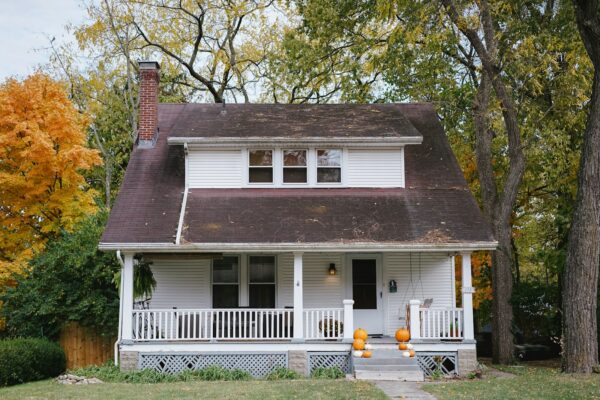
If you are painting the outside of the house, the approach shifts from room by room to the whole shell. You measure the perimeter of the house, multiply by the wall height to get gross wall area, and subtract large openings like windows and doors. Gables, dormers and multiple stories add area, and trim, fascia, soffits and any siding texture change your paint totals. Rough or porous siding drinks more paint than smooth, dropping coverage well below the 350 to 400 figure. For the exterior measuring workflow and the typical quantities, our references on how much paint for a house exterior give hedged ranges you can check your own math against.
Story count matters a lot on exteriors. A two-story home has roughly double the wall height of a single story, so it needs far more paint than its footprint suggests, and it also needs safe access to reach the high areas. Whether inside or out, the same rule holds: measure paintable area, subtract openings, divide by the real spread rate, multiply by coats, and add a margin.
Sanity-Check Against House-Size Benchmarks
Once you have a whole-house total, it helps to compare it against typical benchmarks for a home your size. If your number is wildly different from the usual range, you probably missed a room or double-counted somewhere. Our reference on how much paint for a house interior gives interior ranges, and size-specific guides like how much paint for a 2000 square foot house and how much paint for a 3-bedroom house interior give you concrete anchor points. These are hedged ranges, not fixed figures, so treat them as a gut check rather than gospel.
Benchmarks are useful precisely because whole-house estimates have the most room for error. A single forgotten stairwell or an underestimated coat count can swing your total by gallons. If your measured number and the benchmark disagree sharply, revisit your checklist before you buy.
Keep Walls, Ceilings and Trim on Separate Lists
The single habit that keeps a whole-house estimate honest is separating your three categories from the very first room. Walls, ceilings and trim use different products, often different sheens, and frequently different coat counts, so mixing them into one big number leads to buying the wrong amounts. Wall paint is usually an eggshell or satin, ceiling paint is a dedicated flat, and trim is a harder enamel. If you total them together, you cannot tell how many gallons of each to buy. Three running columns solve this. Every room contributes to all three, and at the end you convert each column to gallons on its own.
This separation also makes it easy to phase the work. Many people paint ceilings first, then walls, then trim, and having three clean totals lets you buy each product as you reach that stage rather than all at once. It also makes returns simpler if you overbought in one category. When you sum your columns, apply the coats and the 10 percent margin to each independently, because a wall might need two coats while the ceiling needs one and the trim needs two over a primer.
Planning Access and Sequence on a Whole House
A whole house is not just more paint, it is more logistics. Tall stairwell walls and high ceilings need ladders or poles, and exteriors need safe access to upper stories. Factor the sequence into your plan: prep and prime first, then ceilings, then walls, then trim and doors last so fresh trim enamel does not get rolled over. Prepping surfaces properly also affects how much paint you use, since a smooth, clean, well-patched wall takes paint more evenly than a rough or dusty one. Our guide on how to prep walls for painting covers the cleaning, patching and sanding that make your coats go on predictably.
Good prep is not just about looks. A poorly prepped surface can force an extra coat to hide flaws, which quietly inflates your paint total beyond what your measurements predicted. Budgeting a little time for prep often saves a gallon or two across a full house, and it makes the finish last longer, which is the real payoff on a project this size.
Common Whole-House Mistakes
The mistakes that bite hardest at house scale are the same ones from single rooms, just multiplied. Using floor area instead of wall area undercounts every room. Forgetting the second coat can halve your estimate. Skipping small rooms, closets and stairwells leaves you short. Mixing up wall, ceiling and trim totals leads to buying the wrong products in the wrong amounts. And rounding down across many rooms compounds into a real shortfall. Keep the three categories separate, plan coats honestly, and round up each can.
Because a whole house is a big purchase, it is also worth thinking about cost, not just quantity. Once you know your gallons, our guide on the cost to paint a house helps you translate paint and labor into a budget, and a house painting estimate gives you a structured way to price the whole job.
When to Just Use the Calculator
Honestly, this is exactly the scope a calculator was built for. Adding up many rooms by hand is where mistakes creep in, and a tool does the summing, the coat multiplication and the waste margin automatically. Enter each room’s dimensions, pick coats and surface type, and the paint calculator totals the house for you. If you would rather have a professional measure and quote the whole project, request a free painting estimate and compare it against your own room-by-room numbers so you know you are getting a fair figure.
A template is a starting point. This does the work.
PaintPricing produces an itemised, branded estimate you can send from your phone, without rebuilding the spreadsheet for every job. Free for your first 3 quotes, no card required.
Frequently asked questions
How do I estimate paint for a whole house?
Measure each room’s walls, ceilings and trim separately, subtract large openings from wall areas, divide every surface by roughly 350 to 400 square feet per gallon, multiply by coats, add about 10 percent, and sum every room. Keep walls, ceilings and trim as separate totals because they use different paints and coat counts.
Should I measure walls by floor area or wall area?
Always wall area, never floor area. Wall area is the room perimeter times the ceiling height, minus doors and windows. Floor area is unrelated to how much wall you have to paint and will undercount every room. Use floor footprint only for ceilings, where length times width is correct.
Do I count trim, closets and hallways?
Yes. Trim, closets, hallways, stairwells, laundry rooms and bathrooms all add up and are the surfaces most often forgotten. Stairwells especially have tall walls that use a surprising amount of paint. Include every space on your checklist so your whole-house total is not short.
How is exterior different from interior?
Interior is estimated room by room, adding walls, ceilings and trim. Exterior is the whole outside shell: perimeter times wall height minus openings, plus gables, dormers, trim and fascia. Rough or porous siding covers less area per gallon than smooth interior walls, and multiple stories multiply the height and the paint.
How many coats should I plan for a whole house?
Two coats is the typical default for durable, even color, especially on walls and any color change. Ceilings staying the same color can sometimes take one coat. Bare drywall and stains need primer as a separate coat. Since coats multiply your total directly, plan for two when in doubt.
Why use the calculator instead of doing it by hand?
A whole house has many rooms and surfaces, which is exactly where hand-tallies go wrong. The calculator does the summing, coat multiplication and waste margin automatically, so you avoid missed rooms and math slips. It is the tool built for this scope, and it turns your measurements into a reliable gallon count in seconds.