In this article
- What owners actually want painted in a garage
- Splitting the structure into lines
- Ceilings, beams and working overhead
- Columns, bands and wayfinding colors
- Curbs, bollards and safety yellow
- Striping, stalls and accessible spaces
- Concrete that is wet, salty and cracked
- Traffic coatings belong to another trade
- Washing decks and handling the water
- Working level by level around parked cars
- Lifts, low ceilings and ramps
- Stair towers, elevator lobbies and pedestrian areas
- Writing the parking garage estimate
- Recording what each level took
- Frequently asked questions
Parking garages are some of the least glamorous buildings a painter works in, and some of the most rewarding to price well. Owners of garages at hospitals, offices, apartments, airports, malls and city centers repaint them to brighten dark levels, improve wayfinding, cover stains and make users feel safer. The work is large, repetitive and full of hidden costs, from the cars that cannot be moved to the concrete that sheds paint because it is wet from above.
This guide is for the painting contractor pricing the painting of a parking structure: ceilings, beams, columns, walls, stair and elevator cores, curbs and the markings that tie it together. It explains how to split the garage into lines, what the concrete needs, how to work around traffic, and what belongs to other trades. The striping side of parking work is covered as a business in the parking lot striping business, and safety marking on floors and walls is covered in floor marking paint. This post is about the structure and the price.
What owners actually want painted in a garage
The scope of a parking garage job varies widely. Some owners want the ceilings and beams painted white to brighten the levels, which can make a dark garage feel far safer and help the lighting do its job. Others want the columns painted with level colors and numbers for wayfinding. Others want the walls, curbs, stair towers and elevator lobbies refreshed. Many want all of it, along with new striping.
The first job on the walk is to agree exactly which surfaces are in scope, level by level. A garage with a white ceiling, color coded columns, painted curbs and new stripes is a combination of very different work, each with its own rate. A clear scope avoids the argument at the end of the job about whether the beams, the stair walls or the ramp soffits were included.
Splitting the structure into lines
A parking garage estimate works best when the structure is split into parts that behave differently. Ceilings and beams are overhead concrete, often double tees or flat slabs with drop beams, and they are measured by area, adjusted for the beam profile. Columns are counted and banded by size and whether they get a band of color or a full coat. Walls and spandrels are measured by area. Curbs, wheel stops and bollards are measured by length or counted. Stair and elevator cores are priced as their own spaces. Graphics and level numbers are counted.
Separating the lines lets the owner see where the money goes and choose which parts to do now. It also keeps the estimate accurate, because overhead work, column bands and curb painting have very different rates. Bands like these only work when each carries a timed rate, the idea behind painting production rates.
Ceilings, beams and working overhead
Painting a garage ceiling is overhead spray work on concrete. The ceiling is usually sprayed and sometimes backrolled, and the beams and tee stems add a lot of surface compared with the floor area below. Measuring the ceiling by floor area underestimates the job, so the painter should measure the developed area of a typical bay, including beam sides and stems, and scale it up.
Overhead spraying is slow and tiring, and a lot of material ends up in the air. Everything below the ceiling must be protected: the floor, the walls, the light fixtures, the signs, the sprinkler heads, the pipes and, most of all, any cars. Sprinkler heads must never be painted, and conduit, pipes and fixtures should be masked or left unpainted as the owner decides. The method is similar to open ceiling work indoors, covered from the interior side in how to price dryfall ceiling painting, though a garage is usually painted with an exterior grade concrete coating rather than dryfall.
Columns, bands and wayfinding colors
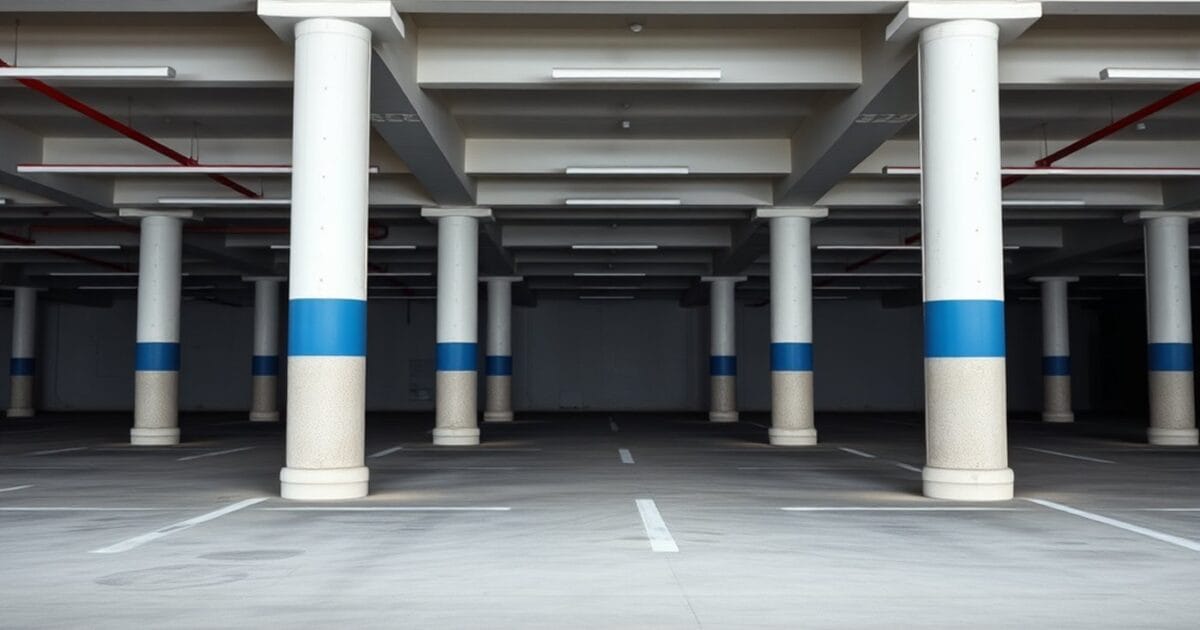
Columns are one of the most visible parts of a garage. Owners often paint them in a color for each level, sometimes with a band at eye level and a level number or letter, so drivers remember where they parked. Some want the whole column painted, others only a band, and many want a protective color at the base where bumpers hit.
Columns are counted and banded. A plain column painted in one color is one band. A column with a color band, a separate base color and a stenciled number is another, because each color change needs masking and cutting. Graphics, arrows and signs painted on walls are counted as items. A level with many columns and graphics can take longer than its floor area suggests, simply because of the number of color changes.
Curbs, bollards and safety yellow
Curbs, wheel stops, bollards, pipe guards and ramp edges are often painted in safety yellow or another high visibility color. They take a beating from tires, bumpers and snow plows, and they are repainted often. Curbs and ramp edges are measured by length and banded by height and condition. Bollards and wheel stops are counted.
These items are small in area but large in time, because every piece needs cleaning, masking against the floor and wall, and careful cutting. The curb painting calculator helps with the lengths, and the conventions for safety colors on floors and edges are covered in floor marking paint.
Striping, stalls and accessible spaces
Many garage painting jobs include restriping the stalls, arrows, crosswalks and accessible spaces, either by the painter or by a striping contractor. Striping is a specialty with its own equipment and methods, and the painter should decide whether to do it or subcontract it. The parking stall striping calculator and the parking lot striping calculator help with quantities.
Accessible parking spaces, access aisles, signs and markings have requirements that the owner must meet, and restriping must put them back correctly. The Access Board explains those requirements in its guide to parking spaces. The painter should not change the layout of accessible spaces without a plan from the owner, and should confirm the layout before painting over existing markings. Treat this page as general information on pricing, not legal or safety advice. The owner and the local authority decide what a given garage must meet.
Concrete that is wet, salty and cracked
Garage concrete lives a hard life. Rain and snow blow in, cars drip road salt and water, and water leaks through cracks and joints from the level above. The result is efflorescence, leaching stains, rust stains from embedded steel, spalled concrete and exposed rebar. Paint applied over wet or salt contaminated concrete will fail, and paint over active leaks will blister and peel.
The painter should identify these conditions on the walk and price accordingly. Efflorescence and stains need cleaning, and heavy staining may need a stain blocking primer. Spalled concrete, exposed rebar and structural cracks are concrete repair, a separate trade, and should be excluded or handled by others before painting. Active leaks should be fixed by the owner first. The estimate should state that failures caused by moisture from leaks are excluded. The same moisture and salt issues on masonry walls are discussed in how to price painting CMU block walls.
Traffic coatings belong to another trade
Parking decks are often protected with traffic coatings or waterproofing membranes that seal the driving surface against water and salt. These are specialty systems applied by trained installers, with their own warranties and inspections. They are not paint, and they are not part of a painting price.
The painter should be clear with the owner about this line. Painting the ceiling does not waterproof the deck above, and paint on the floor is not a traffic coating. If the owner wants the deck protected, that is a separate contractor. The painter may still paint the stripes and markings on top of a traffic coating, but should confirm product compatibility with the coating installer first. The clear sealer side of concrete protection is discussed in how to price masonry sealing.
Washing decks and handling the water
Garage painting usually starts with washing: removing dirt, oil, exhaust residue, salt and efflorescence from the surfaces to be painted. Pressure washing ceilings, walls and columns throws dirty water onto the deck, which drains through floor drains that may connect to storm sewers. Oil and cleaners in that water can be a problem, and some owners and cities require the water to be captured.
The EPA explains the stormwater framework on its stormwater program page. The painter should ask the owner how wash water must be handled before pricing. Washing is best shown as a separate priced item, as explained in how to price pressure washing before painting.
Working level by level around parked cars
The biggest constraint in most garages is that they stay open. Cars park every day, and a garage that closes loses revenue and angers users. The work is usually done level by level or section by section, often at night or on weekends, with areas closed off and cars moved out before painting starts.
Overspray on cars is the nightmare scenario. A single car covered in paint mist can cost more to clean than the profit on a whole level, and a garage full of cars is a garage full of risk. The painter needs a reliable plan with the owner for closing and clearing each section, signage, barriers, and a way to deal with cars left behind. The time lost to cars that are not moved, sections that open late and nights that end early belongs in the price. Staging and night premiums are worked through in how to price a painting job done in phases.
Engine exhaust from traffic on nearby levels and fumes from fuel powered equipment can build up in enclosed levels, so ventilation matters for the crew as much as for drying the paint. The owner may have rules about which equipment can run inside the structure.
Lifts, low ceilings and ramps
Garage ceilings are usually low, which makes them reachable from small lifts, rolling scaffolds or long extension poles. But low clearance also limits which lifts fit, and the weight limits of the deck can rule out heavier equipment. Ramps and sloped floors make lifts harder to position. The top level, which is open to the sky, has no ceiling but has walls, light poles and parapets exposed to weather.
Guidance on working from scissor lifts is in the OSHA scissor lift eTool, and turning lift days into a priced line is shown in how to price access equipment for painting jobs. The rental period should cover every night of work, including the nights lost to weather or closures.
Stair towers, elevator lobbies and pedestrian areas
The stair towers and elevator lobbies of a garage are where pedestrians spend their time, and they are often the dirtiest and most worn parts of the structure. They are also enclosed spaces with doors, railings, signage and sometimes graffiti. They are priced as spaces, with walls, ceilings, railings and doors counted, much like any stairwell.
Railings in stair towers are priced by length and condition, as covered in how to price metal railing painting. Doors are counted, as described in how to price painting hollow metal doors and frames. Where graffiti is a recurring problem, an anti graffiti coating may be worth offering, covered in anti graffiti coating.
Writing the parking garage estimate
A clear parking garage estimate lists the levels and, for each, the lines: ceilings and beams by area, columns by count and band, walls by area, curbs by length, bollards and wheel stops by count, graphics by count, striping if included, stair and elevator cores as spaces. It adds washing, masking and protection, access, and night or weekend premiums.
It states the assumptions: products and coats, surface condition, how sections will be closed and cleared, how wash water is handled, and what is excluded, such as concrete repair, traffic coatings, leak repair, sprinkler and fixture work, and damage to vehicles left in closed areas. The wording for those limits is covered in painting bid exclusions and clarifications, and public garages often come through formal bidding covered in government painting contracts.
Recording what each level took
Garages are repetitive level after level, which makes them excellent to time. On each job, record the ceiling area and profile, the columns and their bands, the curb length, the products and gallons, the crew size and the hours for washing, masking, ceilings, columns and curbs, along with nights lost to closures and weather. After a few garages, the records become rates for the painting estimate rate card.
With those rates, a painter can price a garage by level with confidence and show the owner a clear, itemized proposal that makes it easy to phase the work over several budgets.
Commercial pieces get counted, not buried in the wall price.
PaintPricing builds itemized estimates from your own rates, so doors, lockers, partitions and lift days sit on the quote as counted lines a general contractor can check. Free for your first 3 quotes, no card required.
Frequently asked questions
How do painters price painting a parking garage?
Most split the structure into lines: ceilings and beams by area, columns by count and band, walls by area, curbs by length, bollards and graphics by count, and stair cores as spaces, then add washing, access, protection and night work, using rates from their own jobs.
Why do owners paint garage ceilings white?
A white ceiling reflects light, making dark levels brighter and helping users feel safer. It is one of the most common reasons owners repaint a garage.
Is a traffic coating part of a painting job?
No. Traffic coatings and deck membranes are specialty waterproofing systems applied by trained installers. They should be excluded from a painting price and handled by another contractor.
How do painters avoid overspray on cars?
By working in sections that are closed and cleared of vehicles, masking carefully and controlling spraying. A clear plan with the owner for closing each section is essential before work starts.
Can painters fix spalled concrete in a garage?
Small surface patching may be part of prep, but spalled concrete, exposed rebar and structural cracks are concrete repair and belong to a specialist contractor before painting.
Is restriping included in a garage painting price?
Only if the estimate says so. Some painters stripe themselves and others subcontract it. Accessible spaces and markings must be restored correctly either way.