In this article
Quick answer: Most wood-sided homes need about 6 to 16 gallons of paint for two coats, plus a full prime coat on bare or weathered wood that can add 2 to 4 gallons. Wood is thirsty: raw boards soak up the first coat, and lap or shingle profiles add real surface area. Of all the common sidings, wood uses the most paint and primer for the same house size.
Wood is the surface where under-buying hurts most, because bare boards drink paint and the prep coat is rarely skippable. Buying the full amount up front keeps your color consistent and saves trips, while painters can spec both primer and topcoat accurately. For a quick number, run your measurements through the painting estimate calculator or get a free painting estimate. The breakdown below shows why wood needs more.
Wood also rewards good prep with lower paint use, which is the opposite of how most people picture it. Boards that are scraped, sanded, and fully primed present a sealed, even surface that lets the topcoat spread to its rated coverage. Boards left raw or roughly prepped keep drinking paint coat after coat and never quite even out. So the gallon counts below assume real preparation, and skimping on prep does not save you paint, it costs you paint, because an unsealed surface keeps pulling material into the grain.
How much paint for wood siding
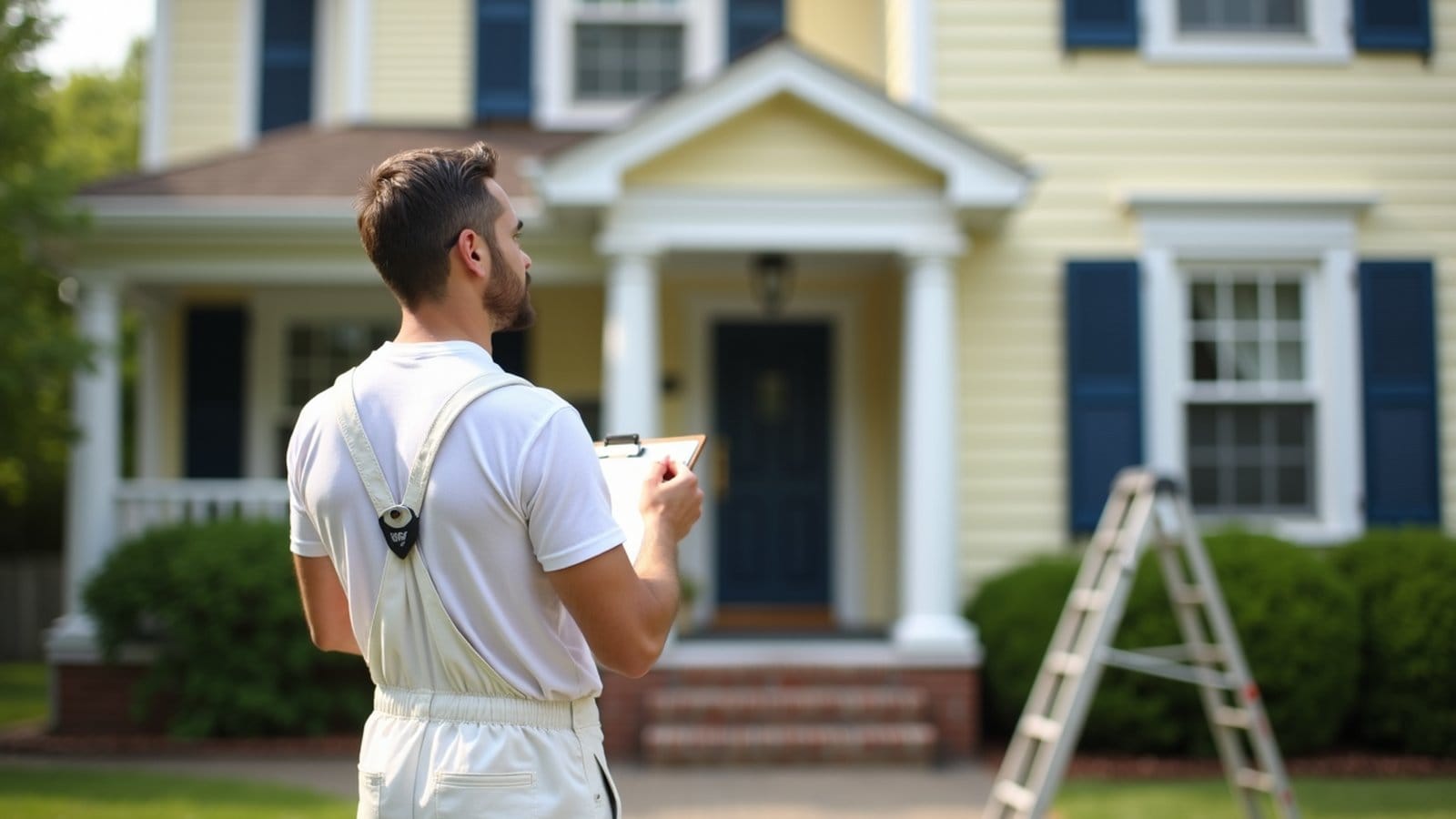
The table is a realistic starting point by house size. Wall area is the painted exterior surface, not the floor square footage. These figures assume two topcoats of quality exterior paint plus a full prime coat where the wood is bare or weathered.
| House size | Wall area (approx) | Paint needed (2 coats) | Primer |
|---|---|---|---|
| Small ranch (1,000 sq ft) | 1,300 to 1,500 sq ft | 6 to 7 gallons | 2 gallons |
| Medium 1-story (1,500 sq ft) | 1,800 to 2,100 sq ft | 8 to 9 gallons | 2 to 3 gallons |
| Large 2-story (2,500 sq ft) | 2,800 to 3,200 sq ft | 11 to 13 gallons | 3 to 4 gallons |
| Extra-large 2-story (3,500 sq ft) | 3,600 to 4,200 sq ft | 14 to 16 gallons | 4 gallons |
The coverage math
The formula never changes: total wall area divided by the spread rate, then multiplied by the number of coats. The spread rate is the square footage one gallon covers. On a smooth, sealed surface a gallon of quality exterior paint covers roughly 350 to 400 square feet, but wood rarely behaves like an ideal surface. Lap siding, shingles, and weathered grain all add area and absorb paint, so wood spreads closer to 300 to 350 square feet per gallon.
Use 325 square feet per gallon for sound wood and as low as 250 to 300 for bare, thirsty boards on the first coat. A 2,000 square foot wall at 325 square feet per gallon needs about 6.2 gallons per coat, or roughly 12 gallons for two coats, before the prime coat. The how much does a gallon of paint cover hub explains how texture pulls those spread rates down.
Wood breaks the usual coat-to-coat pattern more than any siding. On most surfaces the first and second coats use similar amounts, but on bare wood the first coat can vanish into the grain at half the rated spread while the second coat, going over a now-sealed surface, lays at nearly the full rate. So a wood estimate is lopsided: the prime coat and first topcoat are the hungry passes, and the finish coat is comparatively light. If you average the two coats together you will underestimate the first and overestimate the second, which roughly cancels out, but estimating each coat separately gives a far more accurate gallon count on thirsty boards.
This is also why the rated spread on the can is almost meaningless for bare wood. The number printed there assumes a sealed, smooth surface. Raw cedar, weathered fir, and old peeling boards all drink well below it. The honest planning move is to treat the manufacturer figure as a best case you will only reach on the finish coat over good primer, and to budget the earlier coats far more generously.
How to measure your wood siding area
A tape measure and notepad get you there. Capture each wall plane around the house:
- Measure each elevation: height times width for the front, back, and both sides.
- Add the four numbers to get gross wall area.
- Subtract large openings: about 20 square feet per door and 12 to 15 square feet per window. Leave small ones as cushion.
- Add gable ends: width times height divided by two for each triangle, and remember wood gables often hold shingles with extra surface.
- Painters bill by wall area, not floor footprint, so a deeply profiled lap-sided home can carry far more paintable surface than its listed square footage.
If the arithmetic is a hassle, how to estimate exterior painting shows the same steps visually, and how much paint for a house exterior rolls every surface into one whole-house total.
On wood, the profile correction is the step homeowners skip and painters never do. A flat height-times-width measurement treats clapboard as if it were a smooth wall, but the overlapping boards present an angled face plus the exposed bottom edge of each course, which adds real area. For standard lap siding, multiply your flat figure by about 1.1 to 1.15. For cedar shingles or shakes, where every course has deep keyways and irregular butts, multiply by 1.2 to 1.4. Skipping this correction is the main reason wood jobs run short, because the shape of the siding hides as much as a third more surface than the tape measure sees.
What changes how much wood needs
Bare versus sealed wood. Raw or weathered wood drinks the first coat, dropping the spread rate well below 300 square feet per gallon. Previously painted wood in good shape behaves far better. The thirstier the wood, the more both your primer and first topcoat will swell.
Profile depth. Flat board-and-batten covers efficiently, but deep clapboard, shiplap, and especially cedar shingles or shakes have far more surface per square foot. Shingle walls can use 20 to 40 percent more paint than a flat wall of the same dimensions.
Color and condition. Covering dark, faded, or stained wood with a new color may need a heavier second coat. Cracked or peeling boards also hold extra paint in the rough spots. Spot-repair and a full prime coat even out the absorption so the topcoat goes further.
Trim, soffits, and the end grain. Wood houses tend to carry a lot of painted trim: window casings, corner boards, fascia, frieze, and the rake boards that run up each gable. All of it drinks paint like the siding does, and the cut ends of boards drink the most of all, since exposed end grain is the thirstiest part of any piece of lumber. Sealing those end cuts with extra primer is both a durability step and a reason the primer line runs higher on wood than the flat math suggests.
Stain versus paint history. Wood that was previously stained rather than painted behaves differently under a new coat of paint. Solid stain can be painted over after priming, but semi-transparent stain has soaked into the wood and left an open, absorbent surface that pulls paint in fast on the first coat. If your siding was stained before, treat it like bare wood for absorption purposes and budget the generous first-coat figures, not the sealed-surface ones.
Do not forget primer
Primer is essential on wood, especially bare or weathered boards. A quality exterior primer seals the grain so the topcoat does not sink in, blocks tannin bleed from cedar and redwood, and gives the paint a uniform surface to grip. Plan a full prime coat at 250 to 350 square feet per gallon, which is 2 to 4 gallons for a typical home, more if the wood is raw. Wood needs the most primer of any common siding. The how much primer do I need guide covers wood primers and tannin-blocking products.
A worked example
Take a large two-story with cedar lap siding and 3,000 square feet of measured wall area after subtracting doors and windows and adding the gables. Sections are bare from weathering, so we prime the whole house, then apply two topcoats.
Primer first: bare cedar spreads near 300 square feet per gallon, so 3,000 divided by 300 is 10 gallons. That is steep, so re-check, since only part of the wall is fully bare. At a blended 350 square feet per gallon it is 8.6 gallons, round to a practical 3 to 4 gallons for the worst sections plus spot-priming elsewhere. Topcoat is two coats, 3,000 times 2 equals 6,000 square feet, divided by 325 is 18.5 gallons, but the primed surface paints better near 375, giving about 13 gallons. Round to 13 gallons of topcoat plus 4 gallons of primer, and hold a quart for touch-ups.
The cedar detail matters here beyond just absorption. Cedar and redwood carry natural tannins that bleed through ordinary paint as brown or yellow stains, especially around knots and at the wet underside of laps. A standard primer will not stop it. You need a stain-blocking primer rated for tannin bleed, and you may need two thin coats of it over knots even when one coat covers the field. That can nudge the primer line up another gallon on a knotty cedar house, which is exactly the kind of surprise that sinks a too-tight estimate.
Buy a little extra
- Thirsty grain: bare wood swallows more than the math predicts on the first coat.
- Profile grab: clapboard, shiplap, and shingles hold far more than a flat wall.
- Second-coat reality: a sunk-in first coat usually needs a generous second pass.
- Future touch-ups: keep a sealed quart so one weathered board never means repainting a wall.
- Dye-lot matching: buy all your gallons at once so the color stays uniform across batches.
Adding 10 to 15 percent to both your paint and primer totals is wise on wood, since absorption is the hardest variable to predict on this surface. The first coat is where the cushion earns its keep, because that is the pass that disappears into the grain before you can gauge how thirsty the boards really are. Many seasoned painters buy the primer and first coat a little heavy and the finish coat right to the calculated number, since the finish coat over sealed wood is the most predictable of the three. If you are working with bare cedar or shakes, lean toward the top of the 15 percent range rather than the bottom.
With your gallons settled, price the job in a minute using the painting estimate calculator or get a free painting estimate that includes labor. To budget the project, see the cost to paint wood siding, plan your schedule with how long it takes to paint wood siding, and compare nearby surfaces in how much paint for vinyl siding, how much paint for aluminum siding, and how much paint for a brick house.
Frequently asked questions
How many gallons of paint do I need for wood siding?
Most homes need 6 to 16 gallons of topcoat for two coats, plus 2 to 4 gallons of primer. A small ranch runs 6 to 7 gallons of paint, a large two-story 11 to 16. Measure your wall area, divide by 325 square feet per gallon for sound wood, multiply by two coats, then add a full prime coat for bare boards.
Does wood siding need more paint than vinyl?
Yes, noticeably more. Wood is porous, so bare boards drink the first coat and spread closer to 300 to 350 square feet per gallon versus vinyl’s 350 to 400. Deep lap and shingle profiles add surface area, and wood almost always needs a full prime coat. For the same house size, wood uses more paint and far more primer than vinyl.
How much primer do I need for wood siding?
Plan a full prime coat at 250 to 350 square feet per gallon, which is about 2 to 4 gallons for a typical home, more if the wood is raw or weathered. Use an exterior wood primer, and a tannin-blocking primer on cedar or redwood to stop bleed-through. Wood needs the most primer of any common siding material.
Can I paint wood siding with one coat?
One coat almost never covers wood evenly. Bare grain absorbs the first coat unevenly, leaving blotchy color and thin protection. A full prime coat plus two topcoats is the standard that holds up to weather. Budget your gallons for primer plus two coats so the finish lasts years instead of needing an early repaint.
Why does wood siding use so much paint?
Wood is porous and absorbs paint, so the first coat sinks into the grain instead of sitting on top. Lap siding, shiplap, and shingles also have more surface per square foot than flat panels. Bare or weathered boards drink even more, which is why wood needs a full prime coat plus two topcoats and the highest gallon counts of any siding.